Showing posts with label Israel. Show all posts

Sunday, September 30, 2012

Remembrances of the Holy Land (Prologue)

prologueI
Graphic: Robert Marshall

I can hardly believe next April will mark five years since I took what is turning out to be my trip of my lifetime – My pilgrimage to Israel and Jordan.

Despite occurring prior to my starting Robert's Ramblings, I had intended to journalize everyday through a blog so I'd be able to capture my thoughts, fresh in mind.

Alas, I didn't. I didn't even write a single entry summarizing the trip once we returned home. That error in omission is all water under the bridge now.

What follows is partially an exercise in jogging my memory, and partially wanting to recreate those missing journal entries before they fall even further from my recollection. (I hate to call it a memoir because that sounds so serious and suggests finality).

* * *

At first I went through my limited amount of photos I'd taken, along with those taken by Dave Young Kim, one of the ReGeneration interns, who was tasked with taking photographs for the church.

You will find copious amounts of hyperlinks to other source material, such as locations, religious explanations, and words that I figured some people might not necessarily know.

Once the first draft was completed, and I'd had a chance to do a second reading to clean up errors and clumsy wording, I took at look at any trip photo albums others may have shared through their Facebook profiles.

Originally, I'd hoped I would be able to remember enough to create two to three blog posts summarizing things - give or take 3,000 words. It is now two weeks later and the length has ballooned to 15 blog entries, containing over 31,000 words.

As I started writing, things just kept popping into my head. (Which I hope is a good thing!).

Most entries cover a single day. However, a couple days were broken into two parts because they became so long. Rather than boil it down considerably, I decided to keep what came to mind. Think of it more as a personal travelogue, interspersed with comments along the way.

I'm sure there are items I've forgotten, or possibly had a different take from other people on the trip, and I should probably apologize in advance if you find any of the items I recalled monotonous or inconsequential at best.

* * *

I've chosen to use initials when I'm referring to people on the pilgrimage other than our guides, Doron (Israel) and Robert (Jordan). Hopefully, that shouldn't take away from the worth of the piece, and those that went should be able to remember which initials refer to whom.

TO: BP, CB, CH, CM, DB, DE, DK, ED, GC, HS, KG,  LL, MG, PD, PW, RC, RP, RW, SH, ShL, StL, RF, RV, TB, TS, WC and YB, Thanks for being my traveling partners.

To: Doron and Robert (our guides) thanks for helping to expand our knowledge and understanding where historical events fell - especially with a Biblical perspective.

* * *

Lastly, I've decided to back date the entries to the actual dates as if I'd followed through with my original plan. Admittedly strange, but it seemed like a smart thing to do. Clicking on the "TO BE CONTINUED" link at the bottom will take you to the first trip entry (April 9th, 2008).

Enough with explanations! Thanks for reading and I hope it inspires you to go on pilgrimage yourself (or again if you've already been).

TO BE CONTINUED…

Monday, April 21, 2008

Remembrances of the Holy Land (Epilogue)

OVERLOOK
PHOTO: Doron Bookshtein

If you've spent time reading any of the trip blogs, Thank You!
If you've read through all 14 parts, I applaud you mightily!!

FINAL THOUGHTS

There are pluses and minuses to going on an organized pilgrimage. We had 28 people in our group, including guide, a nice intimate size. Everybody pretty much got along with everyone else and the size was small enough that we were able to use a single bus. ReGeneration's previous group had around 40 people and required two buses.

I had chosen the single room upgrade option. At first glance it's wonderful to be able to go back to your hotel room and simply vegetate in silence. Also, you can pretty much unpack your baggage and spray it across the whole room without much worry. Clearly an upside for anyone who isn't a Neat Freak.

However, there was a downside. Sometimes it's too easy to go back to the room and bask in solitude. With the exception of the first night in Amman, and that Tuesday in Jerusalem, I never really did do anything in the evening with anyone else. Had I been in a double occupancy room, no doubt I would have went out purely due to peer pressure.

Having the single room option sort of puts one out of the loop on many simple things, and it's not in my character to overtly search out what others are doing. Nor did anyone really go out of their way to share what they were doing in the "off-time." (In no way am I suggesting it was their responsibility to).

If you're one that feels you must have a single room. I can understand that. Just make sure you make that extra effort to constantly be involved!

Additionally, in a nutshell, I went halfway around the World to watch television, and it wasn't even Israeli television! The whole idea of catching the Sharks' playoff games in the evenings may have sounded good on the surface. However, it relied on Internet that was either spotty at best, or ridiculously expensive. I should have just got over the idea I'd be missing the first round of the playoffs and explored where I was. Meaning, throw yourself 100% into your trip!

Before the trip I'd purchased The Christian's Guide to the Holy Land on recommendation by trip leaders, going through and highlighting everywhere we were supposed to go. Then I barely touched the book. While it had nice blurbs on everything over there, including Bible passages for each location, I didn't use it nearly as much as I could have.

I cannot stress enough that one should read their Holy Bible!! It goes without saying that a Christian should read their Bible. However, there were points where Doron and TS talked about things happening which I was vaguely familiar with. Had I been more versed in Bible reading it would have been more enjoyable.

One should also spend time trying to understand the current political situation that exists today. I had picked up The Palestine – Israeli Conflict, A Beginner's Guide which some regarded as the most balanced book on the conflict. The first part was written by an Israeli, while the second part was by a Palestinian. I'd only finished the Israeli section before the trip, so didn't have an idea of what to look for.

Keep a journal!!! I wish I had. In writing these trip blogs, I relied on photographs to jog my memory. I'm sure I've forgotten things I would have recorded at the time, and I might have been more choosy in what I did record.

I asked several trip members whether they'd kept a journal. Sadly, those that did respond said "no."

My trip was in 2008. Small portable computer devices have expanded like crazy since then, especially with a myriad of tablets out there. If a person owns a laptop or tablet, they MUST take it with them. If not to check email, then simply to keep a journal and to backup photos to from the day's shooting.

That brings me to another item; a good camera. I went the extreme, dripping with a high end dSLR and several pro-quality lenses, along with all sorts of things need to support that. It produced great quality photos. Far superior than any point and click might. But, it didn't produce squat once it stopped working. I foolishly left a backup body to save a little weight. Never again!! I also brought a tripod and a monopod. With the exception of the night shots at Kibbutz HaOn, the tripod was just taking up space.

Do yourself a favor and get the best quality camera you can afford. dSLR are coming down in price significantly, as are the removable lenses, which provide a far better quality than most consumer cameras. Whatever you're considering, a camera on a phone is NOT an option. (Someone recently photographed their wedding with an iPhone. Mark my words that they're going to regret that some years from now.)

No matter what camera equipment you end up with, don't be afraid to click that shutter button. We're no longer in the age of film where you have to be selective. Shoot freely, download them to your computer at night, and then delete garbage that will never be used! Otherwise you may end up with 10,000 photos, three-quarters which are out of focus, blown out, too dark or just plain bad.

If you're on one of the major cell phone carriers there's a good chance they will operate in another country. Do your research ahead of time. I have Verizon, which operates in Israel and Jordan. Before going, I found out that they had a Blackberry loaner program, which allowed me to spend some extra money for the month and have data connectivity, as well as make phone calls, for one (relatively) low price.

Another person had her 1st Gen. iPhone, which was only on AT&T at the time, and she was able to make phone calls only some of the time. The lesson is you don't need to get a burner phone locally just to be able to calls inexpensively. You just need to make sure you have the right plan.

Don't be afraid to actually buy souvenirs along the way. I ended up with very little souvenirs, and what I did buy, is nothing I'm overly excited about. Though it would have probably simply ended up on my wall I sure wish I'd bought a shofar, like CM did. They're totally cool and sure are a conversation piece!

Would I go again? Absolutely!! After coming back I found there were lots of things we didn't see even at the sites we went to simply because of time.

Would I try to go it solo? Yes again. However, you have to really consider what you're going to do, and what you're going to miss without a traveling partner.

Even if you were to stuff your mind with all sorts of data, it's just not the same as having someone to share the traveling experience with, or a guide who is well versed on the subject. Having a traveling partner also gives you an extra sense of security in some of the lesser safe-feeling areas.

If you do decide to go it on your own, plan your trip strategically. Unless you're going to spend months over there, you're probably going to have to trim some places out so you can concentrate on others, and not leave lacking. Petra, Jerash and Aqaba were amazing places to experience. But, I have to wonder if we hadn't spent the time in Jordan, could we have seen lots more in Israel (regardless of the cost factor)?

Remember to bring your ATM card with you. Banks are plentiful in that the cities and your card should work in most ATMs, depending on your financial institution, without a big exchange fee. This way you won't have to carry cash with you into the country you're visiting, and you're less likely to end up at home with a ton of unspent foreign currency.

If you're in Jordan, US Dollars were accepted fairly frequently. Less to some degree in Israel.

Don't just eat in fancy restaurants, and you must seek out shawarma and kanafeh!! There's something special about eating shawarma from a street side vendor in Nazareth! (For you vegetarians, you can get falafel if you must).

Lastly….HAVE FUN!! It might just end up being the trip of your lifetime!!

--FIN--

Thursday, April 17, 2008

Remembrances of the Holy Land (Dead Sea)

DEADSEAPHOTO: Dave Kim

Today we were to leave our second home away from home on this trip. While I still think I enjoyed living in the Galilee more, the hustle and bustle of Jerusalem had grown on me. There were just so many sites left unseen.

Morning came. Breakfast was a bit on the spartan side. Gone was the sumptuous international buffet with all sorts of offerings. With Passover starting this evening, the hotel had been cleaned from top to bottom to get rid of any non-kosher or leavened items.

Also gone today was Adi, and the big blue fish bus. Instead, we had a golden-colored bus which was a bit older, and not nearly as posh-looking. It took a little while to get used to it. Don't remember the driver's name.

We cut through an Hasidic neighborhood to the north before catching Highway 1. I tried catching some photos from the bus, but it was a wasted effort with the replacement camera smearing most anything that was just across the street.

As we climbed up over that last ridge, and the Old City passed from view, I started thinking about how most of our trip was behind us. One of the things that I was looking forward to was the next day's visit to Petra. However, it was still bittersweet to be leaving. Most Christians, and a fair amount of Jews, never set foot in the Holy Land, let alone Jerusalem. We'd been blessed with that experience.

Jerusalem is actually in the hills, as compared to most of Israel. In the Bible, it was traditional to say, "…going UP to Jerusalem" and we now found out why. We started losing altitude noticeably, passing through mostly rocky terrain, interrupted on occasion by the West Bank Barrier and new-looking settlements atop the hills.

Though we had entered the Jordan River Valley, it looked nothing like what we'd seen during our first few days. The area was very arid reminding me a lot of the western Mojave.

We came to a crossroads and headed South into the Dead Sea region. It's funny to think that we were now driving through the lowest point on Earth.

Being this close to the West Bank territories, the Israeli Army had set up checkpoints with huge stone blocks, alternating between lanes. This forced traffic to slow to a crawl before slowly snaking through the chicane, or possibly waved to a stop for inspection.

We finally got our first view of the Dead Sea. The aqua blue of the water absolutely glowed when compared to the pale yellow dirt and salt formations.

This area was pretty empty, lest for the occasional building. Then we came upon a concentration of nice-looking buildings on our right. This is the Qumran National Park Visitor's Center.

Qumran is where a boy, during a search for his wayward goat, discovered a bunch of clay jars inside caves. The clay jars turned out to hold part of what we now know as the Dead Sea Scrolls and this cave complex, as a whole, has turned out to be one of the most important findings for biblical era schools ever found.

We walked into the Visitor's Center, which looked extremely new. We wound through the museum looking at examples of the Scrolls, and Essenian life, before being ushered into a small theater where you leaned against the wall or railings for a relatively short video presentation.

Suddenly, a set of doors opened to our left, exposing us to harsh daylight with no warning. It is sooooo bright out. Bright blue sky with zero clouds. A dry wind whipping off the Dead Sea. Even with my glasses having two layers of tinting were not helping to fight the migraine that was coming on.

Besides the building there was a cactus with Hebrew graffiti carved into. It. Thinking it was cool-looking, I grabbed a few shots. PD shook his head, chastising the graffiti artist, or perhaps it was more of my wanting to take the pictures? Not exactly sure which it was.

A local interpretive guide took us on a reasonably long walk through the Qumran ruins. We weren't able to actually get close to any of the caves, as they were in the hills, and eroding badly.

I think the neatest things were the huge mikva'ot. Even in such an arid environment the priests went all out to build huge ritual baths, when in other circumstances they were no bigger than a microwave oven.

We spent some time in front of the Scriptorium where the guide explained about the hard life of the Essenes, as well as some alternative theories that Qumran really wasn't a community of scholars and priests. At this point, none of them really stick in my mind.

Doron told us this would be our last chance to buy any souvenirs in Israel, and highly recommended the Ahava cosmetic products that were World renowned. I really hadn't bought anything on the trip and figured I'd make a conscious effort to do so.

For my sister and a high school friend, I bought each some mud products and bath soaps. For myself, I chose a small bottle of Date Wine (A specialty of the region) and a replica Dead Sea Scroll jar.

Someone commented that this was the first time they actually saw me buy anything on the trip, and, for the most part, they were probably right.

Probably, the best purchase made by anyone in our group was CM's Shofar. Being a musician, it was a fitting purchase. It must've been somewhere around three feet long, and glistened in the light. The gift shop was set up to ship items, such as that, so the purchaser wouldn't have to drag it around on their trip.

Back on the road, we headed south. Sometimes the road was relatively close to the Dead Sea shoreline. Other times higher up on the ridge, allowing a commanding view for anyone sitting on the left side of the bus. What I found fascinating were the huge multi-colored circles along the shoreline.

These were mineral pools which will eventually lead to sinkholes, accentuated by the continued over dependence on Jordan River water for irrigation and the growing population. No wonder there were plenty of warning signs.

Sadly, the oasis at Ein Gedi was not on our itinerary. TS had talked it up in pre-trip meetings, but we were crunched for time due to our being on the cusp of Passover.

One of the things I'd noticed was that there was pretty much no industry along the Dead Sea. There's a land bridge which slices the basin into two water sections. Located around this shallow area are the unmistakable reddish brown evaporation ponds, along with machinery and buildings made decrepit looking before their time by the harsh saline environment.

Despite my disappointment of not seeing Ein Gedi, I was eagerly anticipating our next stop as we now pulled onto a side road to Masada, where nearly 1000 Jewish rebels killed themselves, rather than become enslaved by the 10th Roman Legion.

My first introduction with Masada was not from any history book or documentary. Rather, it was the 1981 ABC miniseries, staring Peter O'Toole.

Spending zero time at the newly built Masada Museum, we saw a short video on the siege before heading up the three minute cable car ride to the top. As the cable car climbed, you could look below and see those poor souls that decided to save US$11 so they could spend 90 minutes slogging up the Snake Path, used for nearly 2000 years.

We were deposited just below the summit. Off to the left was a metal walkway, suspended from the side of the cliff. The feet echoed as we walked across the open grid decking. Once through a building, the visitor is treated to the summit, which is essentially flat, with a slight slope to the east.

From the western rim you could look down and see the outlines of where some of the Roman Legion encamped while building their siege ramp. One could also easily make out the dirt ramp, which  people can use as an alternative access to the summit.

We saw one of the huge cisterns that collected water for the inhabitants. Without those, Masada wouldn't have been habitable. There was an overlook which allowed a view of Herod's 3-tiered fortress which sits on the north side like a like a captain's command console on a ship.

Some of us wanted to take the Palace Trail to get a better look. However, Doron said it would take too long (and it was a moot point as the area was going through renovation).

We started looping back through some of the buildings which have been stabilized for interpretive displays. The spa was pretty cool as you could see the under flooring where the heating elements were.

As we cut through a ruin we noticed a small flock of black birds perched on the rock work. The apparently sit around waiting for tourists to give them food. SeL and CH had some type of bread or chips and when they offered it up, the birds hopped on their outstretched hand with no hesitation at all.

Most people spend several hours to see Masada. It seemed like we were there for about an hour, at most.

While visiting the summit there was barely a breeze. But, as we neared the exit to catch the cable car a breeze kicked up, causing the Israeli flag to flap proudly in the wind. I was able to grab a great shot with the Dead Sea in the background.

When we got to the ramp RP asked me if I'd like him to take my picture. I hadn't really had my picture taken anywhere so told him yes. I wish I could say it was a good photo. However, my hair was all over the place, and my sunglasses were pitch black. Still, it was better than nothing, and I appreciated his asking.

WC and DK tried to talk Doron and TS into letting them run down the Snake Trail. But, that wasn't going to happen, so everyone took the cable car. At the bottom the driver pointed out a group of Ibex on top of a stone wall. I really missed my good camera and zoom as the 10x digital zoom on the Fuji camera turned out pretty anemic.

It was now time for a cliché - floating in the Dead Sea!

Because the water is so concentrated with salt, about the only thing you can do is float. The more you try to go under water, the faster your body bobs up to the surface, like a wine cork. And whatever you do DON'T open your eyes.

We stopped at the seaside resort of Ein Bokek. The resort is nothing more than a handful of hotels and shops which cater to the people who flock to the area to soak in the salty water, lounge under umbrellas on the shore, rinse and repeat.

Tour bus riders were allowed to use the changing rooms in one of the swim suit stores.

A lifeguard sat high up on a pole with a bunch of that white anti-burn paste on his nose, a sailors hat (like what Gilligan wore) and swim trunks. He skin was well tanned from being exposed, and I wondered how many days he could actually do that without earning himself an acute case of skin cancer.

All you had to do was walked into the water and when it was deep enough just lean back. No need to tread water, or even try to swim. It was as if you were laying on one of those soft foam mattresses where your body sinks in a bit and the foam conforms to your body.

The only swimming, if there was any, was all in slow motion. Signs on shore warned people against splashing. I guess DK got a little too active for the life guard's taste, and he started yelling at him loudly.

This was probably the hottest day of the entire trip. The air was thick with oxygen and the sun beat down on you.  Because of the No Splash rule, it was absolutely quiet, which magnified the desolation even more.

While standing, I reached down and grabbed a handful of the sea bottom assuming it was very white sand. It was salt…nothing but salt! No wonder the water was so clear.

Adjacent to where we were floating was an area marked off with big warning signs and floating buoys. As RP and I got closer we noticed a rotten egg smell and a slight bubbling. It must have been some type of underwater sulphur spring.

We could only stand it for 10-15 minutes before the salt started drying our skin out. Coming out of the water, there was an outside shower with three nozzles where people could rinse themselves off.

Once finished, we headed back to the changing room. Unbeknownst to us, the clerk had moved our belongings to a different changing room, and we were greeted with a shriek from a couple of 50-something Israeli women. We apologized and beat a hasty retreat. Only then did the clerk tell us where our belongings were.

After changing we had some time to walk around the little mini-mall. I guessed this place had a lot of Soviet Jews because there were quite a bit of signs in Cyrillic. I feebly tried talking with someone in Russian, but all I accomplished was a bit of embarrassment.

Arriving back at the bus, we found out that DK has managed to cut the sole of his foot somehow. My suggestion that he go stick it in the anti-septic salt water of the Dead Sea didn't go over well. But then judging by the way my clean shaven neck felt when submersed, I could understand.

Sadly, it was time for one of our little family to leave us. ED was staying longer in Israel to visit with a friend she knew from back in the USA. We waited as long as we could. However, she was going to have to wait a couple more hours for a bus going back the other direction.

For the next 2.5+ hours everyone was pretty quiet. The roadway had long left any indication of a waterway, spent the first part of that time following dry wadis, never really gaining much altitude.

The farther south we drove, it started to straighten out as the terrain flattened into a large plain, with the mountains of Jordan coming closer. More and more blocky parcels of palm tree groves popped up, the manicured looking ones with netting to keep birds out.

At some point you could start to make out truck traffic on Jordan's Dead Sea Highway. It seemed funny to have two highways paralleling each other so closely. Sort of like Highway 99 and Interstate 5 through California's Central Valley.

As we neared the end of our time in Israel, Doron got on the intercom. He gave a little speech about how much he'd really enjoyed guiding our group. Once he finished with the group announcement he went person by person to give us all a personal good-bye.

Sitting in the last row of the bus, I was the last person he came to. With a firm shake of his hand, he told me how much I "inspired" him. I'm not exactly sure what I did that caused the inspiration, but I was really honored hearing him say that.

We now reached the Wadi Araba Border Crossing; the southernmost between Israel and Jordan. The driver pulled into a parking lot at the end of the road, and quickly unloaded our baggage. Doron told everyone they were going to immediately leave so the bus driver could get back to his family by sundown. Not only was this Sabbath, it was Passover.

Unlike the first border crossing which was a short walk, this one must've been nearly 200 yards. At least that's what it felt like since the wheels on my big suitcase were all trashed, and the cloth handle kept slipping off its fasteners.

At the Jordanian side we were once again greeted by the a big smiling photo of King Abdullah II which seemed to grace most governmental buildings. There were two guard stations. I decided to try saying "Salam O Alaikum" to the first inspector. Maybe it was my pronunciation or the fact it was twilight, but he looked at me funny and just said, "Hi."

Moving on to the second guard I just said, "Salam" which seemed to be accepted. It was here that our luggage would be searched yet again, and it seemed like it took forever.

While we were waiting for our bags to be prodded through, there  were a couple of garish gift shops to occupy our time. Some of the girls were enamored with some Arabic pop song playing loudly from one of the open front shops. I noticed a little all-white kitten that was extremely friendly. He kept trying to jump on my luggage as is to say, "Don't you want to take me home with you?" (Not sure what Jake and Sally would have thought about another house guest).

Inspections finally finished, we threw our luggage on a bus and headed into Aqaba. Even though Eilat, Israel was a much bigger city, we were staying on the  Jordan side of the border.

TS said the biggest reason being that accommodations would have cost five times as much in Israel. Certainly an added benefit was that it put the border crossing delays behind us as the next day was going to be a long one, with visiting Petra before driving all the way to Amman.

Our motel for the night was the Aqaba Gulf Hotel. I wish I could say that it was very memorable. However, I really can't. That is, unless you count the information sheet in the bathroom which was printed in something like five or six different languages. I'd never seen German on them before. They did have a Rum Bar. However, it had limited hours, and wasn't open when we checked in.

We had no formal plans for the evening in Aqaba. StL and I decided to take a walk a over by the beach area. I expected to walk up and dip my toes in the Gulf waters on an quiet beach. It couldn't have been further from the truth!

Despite it being far into the evening, the beach was absolutely packed with families. Women and girls were modestly attired in Hijab and Abaya. Had they been wearing normal swimwear, you might have confused it for Mexico.

A long paved walkway paralleled the beach and was loaded with stands selling food and souvenirs. We walked for awhile until there was a break in the vendors, with allowed access to another walkway.

StL decided to head back. I kept walking to see just how far it went. A slightly uneasy feeling came over me a couple minutes later when I realized I was without anyone else in the group. But, it quickly diminished. The place was like a busy Saturday night back home and everyone seemed to be enjoying themselves, too busy to worry about the American walking alone.

I finally came to the end of the walk. There was a guy with one of those portable backpacks that serve hot coffee. I wanted to take a photo, but couldn't work up the nerve to. (Photographing people is not my favorite subject).

Three others from the trip happened to end up here too and we walked back through the closest streets of the city where there were shops open even at this time of night.

Next to our hotel was a large souvenir shop. It might have been affiliated. Not sure. They had traditional Arabic clothing, instruments and those curved Janbiya daggers you see in movies.

RV was in negotiation with the clerk over one of those traditional Bedouin sashes which have the metal disks that make noise when they dance. (don't know the name). I left her to try and work him down from whatever high price he tried to get for it. (She ended going without).

I ran into a couple others. However, it seemed like nobody was going to go out for a walk again, so I decided to call it a night. Walking past the hotel's Rum Bar, I momentarily thought about grabbing a drink. But, changed my mind.

As it turned out, a big group went over to the water front. Had I known, I would have tagged along.

I, honestly, wouldn't mind visiting Aqaba again. With the exception of the brief concern I felt when first alone, it had a wonderful festive atmosphere. Just families enjoying themselves.

TO BE CONTINUED…

Wednesday, April 16, 2008

Remembrances of the Holy Land (Tel Aviv)

statuePHOTO: Dave Kim

We took a right as we exited the Old City through the Dung Gate. To our right were the high ramparts of the Old City, while on the left were houses and apartments in the surrounding Arabic neighborhood, interspersed with views across the Kidron Valley.

I stop at calling it a slum, as it was nowhere near as bad as anything I'd seen pictures of from Cape Town or Rio. However, the neighborhood might've already seen its better days. Draped on the iron railing of one two-story house was a sign, in English, which exclaimed, "Another excavation means another neighborhood gone" referring to the recent excavations going on there within the previous few years.

Despite it being 2008, excavations were still in their infancy at the City of David location. A few months prior to our visit, archeologists uncovered many promising ruins in the area believed to be from King David's time. There were several walkways and stairwells which afforded us a close look as crews were still working the location.

Doron asked that nobody take photos at this time because the lead archeologist had not yet published their findings.

Adjacent to the City of David, is the Beit Hatzofeh lookout, which allowed us a great view of the Kidron Valley.

Group members needed to choose one of two tunnel options to tour. The adventurous people chose to explore Hezekiah's Tunnel, a 1750 foot long water route built in 701BC by King Hezekiah to provide a water supply in the face of impending attack. This tunnel was hewn from solid rock, and is quite narrow in points, short in others, and you're guaranteed of getting your feet wet because there's always water running through it, sometimes quite high.

The less adventurous could choose the Canaanite Tunnel, which is much shorter, and more importantly for some, completely dry.

As I'd heard about Hezekiah's Tunnel a year before the trip, there was little question which one I'd choose. About 10 of us went for Hezekiah's Tunnel, with the rest choosing to stay dry. Doing neither was not an option, to the dismay of anyone who may have been claustrophobic.

We all walked as one group down a set of steel stairwells before splitting into the two parties. When we got to where it was time to get our feet wet I was towards the back of the pack. I could hear the people up front screeching as they set food in the water, exclaiming how cold it was.

I was about ready to step in when TG came out of the tunnel. He was a couple inches taller than my  6'3". Apparently, he got 10 feet into the tunnel before whacking his head pretty good. Not wanting to tempt fate he decided to switch and take the dry route, with its more ample headroom.

The water came up to just above my ankles. I was wearing Teva sandals, so my skin was fully exposed to the water. It was actually very exhilarating.

There's no lighting in the tunnel so they gave you a little disposable light when buying your ticket. They claimed they were enough light to experience the tunnel. However, they gave off only a small amount of light. Some people brought flashlights.

You basically had to keep going as there no places to stop, nor wide enough to allow anyone to pass by. Because of this we completed the walk in about two-thirds of the normal time estimate. It didn't help there was a group of young Israeli teenagers immediately behind our group, pushing the pace.

Height and width of the tunnel varied. Upon first entering, the ceiling height is short, though the width is reasonable. Towards the last part the height is quite high, but there were a few points where my girth caused me to turn sideways to continue moving forward. At no point did I feel I'd get stuck, but it certainly became interesting at times.

All along, there was a constant din of water being sloshed around by thrashing feet. This, coupled with heightened voices, made it quite loud at points.

We finally exited the tunnel to the lower Pool of Siloam, where Jesus cured the blind man.

At the top of the adjacent stone stairs was a well-placed souvenir stand. They had was a bright t-shirt that said, "I survived Hezekiah's Tunnel." Despite not having a size that fit well, I had to get one!

So was it wet? Yes. However, I was disappointed because it never got more than halfway up my calf and I'd seen pictures where it got waist deep on occasion.

We next came to an awning covering what looked like one side of a stone pool. For quite some time many people considered this the actual Pol of Siloam.

TS gave a sermon about Jesus and the Blind Man, while Doron covered the historical and archeological aspects. Additionally, there was someone who was selling antique coins which looked more like little flecks of pitted carbon steel than actual money.

Doron took us into an adjacent area where they had excavated a set of sewers. He told us about how Jews had escaped the Romans by crawling through the sewers. He added that they found animal bones which helped to confirm the dating.

Naively, I asked whether they'd found any human remains during their digs to which he quickly said, "That is a question we don't ask." Per Orthodox Jewish customs, it's against the rules to disturb human remains and so if any were discovered the excavation would be immediately stopped while a rabbinical staff came in to investigate.

From the low point of the Kidron Valley and the Pool of Siloam, we returned to our bus to head over to the Mount of Olives Overlook which provides the quintessential view of the Temple Mount and Old City.

We were greeted by a camel sitting at the lookout, which really looked out of place. Apparently the handler hangs out all the time in case people want to be photographed sitting on the camel in front of Jerusalem. MG and CG were photographed together, and then DK took his turn.

The last time ReGeneration Church went on pilgrimage to Israel, the group had nearly 40 people. We had 28 this time, and filled up the lookout quite well. The larger group must've been overwhelming.

We stopped in the German Colony for lunch, a Jerusalem neighborhood which had lots of shops and touristy looking things. After walking around several blocks several of us sought out the nearest shawarma shop to where the bus was parked.

The place was not nearly as fancy as some shops we'd seen, but was very busy and we were able to get tables together in the back.

Interestingly, he used a clean utility knife to cut open the edge of the pita before stuffing it with the sandwich content. Not the tool of choice here in the USA. But it worked!

Before leaving Jerusalem, we'd have the opportunity to see the Coast.

Where Jerusalem is the spiritual center of Israel, Tel Aviv is the cultural and economic center. Many international corporations have offices in Tel Aviv.

Adi parked the bus down along the waterfront. We were told we'd have a couple of hours to go swimming or sight see. Most people immediately headed down to the beach.

I had been resolved to not being able to take anymore photographs on the trip since my camera started malfunctioning in Jerusalem. It was actually a relief not having to carry around all that bulky gear. However, I'd also started getting disappointed that I wouldn't be able to capture anything over at Petra.

With that thought in mind I asked Doron if he knew of any good camera shops in Tel Aviv. He called his daughter, who happened to be a photographer. She recommended one several blocks away. I headed down the street in the direction he said to go.

About half way there I found a different shop. I spotted a used Canon 10D available. The advantage of this would be that I could use all my lenses I'd brought with me. (Ironically, I had a Canon 10D at home. However, at the last second I decided to save some weight and unpacked the body, which would have been a spare.)

Though it was way more than I wanted to spend, I seriously considered it. However, the owner hadn't provided the power supply to charge the batteries. The shop owner called the seller up to see if they were available. However, had to leave a voice mail. Since there was no guarantee the owner would call back, or even had the missing stuff, I reluctantly passed.

I finally reached the original destination. I suppose this place is a wonderful place for someone who either works in Tel Aviv, or is visiting for several days. Unfortunately for me they pretty much have to order everything. I'd be in Jordan by the time anything arrived so it was a worthless venture. So it was now back to the original place.

The used seller hadn't called back yet. On a spur of the moment I decided to go ahead and buy a Point-and-Click consumer camera, figuring any camera is better than none. After looking at several models I ended up buying a Fujifilm Finepix A805.

Feeling a bit of pity, the owner gave me a deal on the Fuji, and even threw in a camera case, batteries and a small SD card. It was funny to see that it had an option for Hebrew in the display settings. Not something you normally see in the USA.

Despite all the running around, I still had time to take a dip in Mediterranean Sea. I was lucky enough to see DK's mother, who was not swimming, and she agreed to watch my new camera.

The Israeli's have built a long line of break walls about 100 yards out from the beach. This allowed for some pretty calm places to wade. The water was actually quite warm compared to what we're used to here in Northern California.

I wandered around the shallow until I ran into some people coming in from the break walls. Not sure if they were supposed to go out there, but a whole bunch had, and apparently you could walk nearly all the way out without leaving your feet.

About three-quarters of the way there I changed my mind because I didn't know if anyone was still out there, and I was getting worried about getting back to the bus in time.

As it turned out, I got back in plenty of time. I actually got on the bus before anyone so took the liberty of drawing the back curtains and changing from my wet suit back into my street clothes.

Little by little, the remainder of the group straggled in. This allowed CB and I to grab a cup of coffee in a shop adjacent to where the bus was parked. This backfired as the line was a lot slower than we though, and now everyone was waiting on us.

Next we drove to the southern Tel Aviv suburb of Jaffa, where Jonah set sail as he tried to escape God's commands.

Jaffa was badly damaged in 1973's Yom Kippur War and so many of its buildings have been rebuilt in the last 30 years. (If you have Netflix you can rent Kazablan, an Israeli musical based on Romeo and Juliet. It was filmed in Jaffa only a year after the war so much of the devastation was still visible).

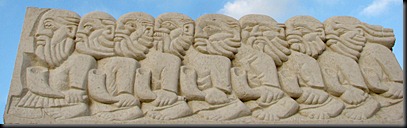
Doron and TS chose Old Jaffa's Abrasha Park for the site of our next sermon. At the top of the hill one had a commanding view of the Tel Aviv skyline. We congregated at a paved area next to the Statue of Faith, a monument carved with three Old Testament stories (the sacrifice of Isaac, Jacob's dream and conquest of Jericho.)

This was another one of those special moments when TS was giving his sermon. Some people almost looked as if they were embraced with a spiritual glow.

On the way back to the bus we noticed a young Israeli couple having their wedding photos taken. Doron explained that this area of Old Jaffa is a popular place to do that.

We ended our evening on the Mediterranean by eating at a sea food restaurant, who's name I've now forgotten.

They sat us along a long table by the window, an equal number of people on each side. Unfortunately, those of us along the window weren't able to move around much, so couldn't converse with everyone in the group. Doron's wife joined us for dinner tonight.

I can't remember all the courses, but there were several, and the food was really good and I think everyone went away happy.

Once dinner was finished we headed straight back to Jerusalem. I'm sure others probably went out on the town. I decided to try and catch the latest Sharks' game. While I did connect fine, I once again missed most of the game. The exercise of trying to keep up with the Sharks was pretty much a waste, and I'd have been better off seeing if anyone was going out.

TO BE CONTINUED…

Remembrances of the Holy Land (The Kotel)

KOTEL
PHOTO: Dave Kim

Today would mark our last full day in Jerusalem. On the elevator ride down an older couple made eye contact with me. Rather than saying "Good Morning" it was "Guten Tag" which reminded me how much this was an International hotel. I nodded acknowledgement as they kept softly speaking in German.

When we reached the lobby I wished I'd tried my very limited German by asking them from where they came and telling them my grandmother was from Klagenfurt, in southern Austria.

We started out by going to the Western Wall (The Kotel in Hebrew), the most holiest site in all of Judaism. Gone were the long lines to get through the two inspection points we experienced two days earlier.

The main courtyard area is divided into four parts. There are two main prayer areas immediately in front of the Wall, separated by men and women. A common area runs the full length behind the prayer areas, separated by a three foot high way. Finally, there's the museum area below several arches to the far left, also cordoned off by a small wall.

We would be visiting the underground tunnels first because groups needed to schedule by reservation. While waiting for our time we had to opportunity to use the restrooms and freshen up.

As we gathered by the entry doors the museum person checked his reservation list. However, he said there was another group booked for our time. Needless to say Doron wasn't very pleased as it had been booked months before.

After they sorted things out they allowed us in. Upon entering there was a long passage way heading off to the right below the arches which were visible from the outside. Nearing the end of the corridor Doron stopped to make sure everyone was with our group. Where was SH?

Apparently not everyone heard the call for our group, but nobody noticed until we' entered the tunnels. Doron told us to wait here while he went to check, saying they'd had people get lost wandering the tunnels.

All accounted for, we continued further into the tunnels to a model of the Temple. An elevated gallery provided seating while Doron gave us a tour of what the old temple may have looked like. It was really cool because he could change the look of the model with a flick of some switches so that specific parts were highlighted.

We next stopped at a huge stone. Doron had me go to the far right side and indicate with my hand where the seam was. He then had RV do so on the far left side, so the group could see just how big it really was (44 feet long, weighing 570 tons).

After walking along the Wall we made a small zigzag, only to be surprised by the sight of several older women praying against the Wall. Doron said that the women had permission to come and go to this point, and some consider it the best place to pray as it was the closest you could get to the inner sanctum of the sanctuary.

Part of me would have loved to have taken photos of the women in prayer because it was such a unique sight. However, it's one of those things I would have thought about because I wouldn't want to intrude on the moment.

Continuing on, we stopped by Warren's Shaft, which had a glass plate, a person could look down. It basically revealed older stones from the collapsed parts of the Wall, knocked down by the Romans.

Doron told the men we had to wait here, taking the women down and around a corner.

After they came back I asked CG what was going on down there? Apparently, it was a women's gallery, close to the Western Wall. What was strange is it was blocked off from the men's section with glass, though she said you could see the men in prayer.

We now wandered through the narrow tunnels that were dug next to the Wall. Wooden scaffolding was above and to our left, holding back dirt to allow for this walkway. I felt sorry for anyone even a small bit claustrophobic.

Part of old Herodian Road was uncovered during the excavations, including a couple tall columns. Doron pointed out this would definitely have been one of the roads at the time of Jesus.

The last part of our underground experience came as we wandered through an old aqueduct, before finishing up at the Struthion Pool once again.

Rather than retrace our steps underground, we now wandered through the Old City, taking the Via Dolorosa and other alleyways. At one corner there was an older Arabic women with boxes and boxes of fresh vegetables. Sure wish my camera had been working at that point.

One of the funnier sites were a group of Arabic women, in their full black Abaya, having an animated conversation while looking at a vendor selling women's lingerie. They didn't sound like they were upset about it. It was more along the lines of how impressed they were. Really funny.

After several alleyways, vacant except for Palestinian graffiti, we came to the security station we'd seen when coming off the Temple Mount. Passing through deposited us back in the Western Wall courtyard.

TS said we would have ten minutes if any of us wanted to say a prayer at the Wall. We went to our respective side of the prayer courtyard. Despite having over two-thirds of the space, the men's side was fairly spartan of prayer goers when we were there.

Some men were standing by the Wall with those small leather boxes tied to their heads and/or long leather straps wound around their forearms. These are called Phylacteries and the boxes contain little papers inscribed with Torah verses. For some, finely ordained yarmulke coverings on the crown of their head were not enough. They also employed prayer shawls. Some had their face's visible. Some completely draped over.

With a leather bound Torah in front of them, they'd sway side to side quickly, or bow back and forth, while facing the Wall. Supposedly this blurs everything else around them so as to be more one with God.

Other men had set up chairs with huge copies of the Torah on lecterns, obviously planning on staying for quite awhile.

My search for a San Jose Sharks' yarmulke defeated, I had to dawn one of the one-size fits all paper ones the Western Heritage Foundation made available for people needing head covering. It didn't fit very wall, but served its purpose, though it blew off once, sending me scurrying to cover my naked head.

Several of us placed our hands on the Wall while saying prayers. Additionally, I had written a small note to tuck in the Wall. It was amazing to see how much paper was folded or wadded up and stuck in the cracks despite young rabbis being in the process of cleaning it out every year for the next week's Passover. (The notes are buried rather than simply incinerated).

Later on CB would say the women's side are fairly packed, and what was funny was that some of the women praying took a moment to grab chairs to put up against the dividing wall so they could peek over at the men's section. There were no men doing the same from our side. (Case of Forbidden Fruit again?)

Here, in the USA, we joke about the Fashion Police. There, in Israel, they are very real.

When visiting the Western Wall, women are to wear long pants or dresses which don't expose the knees, Shoulders and biceps should be covered, be it by shirt or scarf, and the head is kept covered at all times. ED and GC found out just how real the Fashion Police were as a short squat women, in military-like uniform, came over insisting they cover their shoulders.

They both adjusted their scarves. However, GC apparently didn't do a good enough job for this woman's taste, who felt it was her job to actually start grabbing GC's scarf and adjust it for her, all the while being very verbally tenacious.

Understandably, GC got annoyed by all this pawing. The crazy thing is we were all standing in the common area far away from the actual courtyard prayer sections. We left before the woman could return and chastise anyone else.

(Ironically, in 2009  a woman was arrested when she went to pray at the Wall wearing a traditional prayer shawl, and reading from the Torah, actions forbidden to women by ultra ultraorthodox Jews, especially in Israel.)

On a way back to the bus I had another whimsical observation. I'm sure most people are aware that military service is compulsory for all Jewish Israelis once they turn 18, no matter whether they're men or women. (Muslims and Christian Arabs are exempt). There was a squad of girls, probably not more than 18-years-old, standing by.

They were dressed in full military combat uniforms, carrying pistols and on their hips, or with Galil assault rifles slung over backs. If you took the military hardware away, and dressed them normally, you couldn't tell them from any normal high school cheerleaders, purely based on all the makeup they were wearing.

TO BE CONTINUED…

Tuesday, April 15, 2008

Remembrances of the Holy Land (J-Town II)

Garden
PHOTO: Dave Kim

We arrived in the hotel foyer this morning, only to be greeted by signs indicating the main ballroom was still closed, and pointing us to a different alternate location for breakfast.

Before heading over I peeked in the main room wondering why it would still be closed hours later. It was an absolute disaster area. Tables all over the place. Garbage bins brimming with full green plastic trash bags. Some busted stuff on the floor. (So this was the aftermath of a traditional Jewish wedding? Wow!!).

The layout of the new alternate place leaved a lot to be desired. Lines snaked amongst round tables, and moved at a snail's pace. As it was a buffet you were allowed to go back for as much as you wanted. But, with the lines as bad as they were, it would just burn a lot of time to do so.

Additionally, they labeled the soda machines with a sign saying, "Do not fill your water bottles." Strange considering I hadn't seen many people doing that previously, nor were they running out any time soon.

Breakfast complete we headed to our first stop (Mount Zion) to visit the site commemorating where Jesus held the Last Supper with his Disciples. Doron pointed out that we really don't know where it actually took place as all of these buildings were built long after the time of Christ.

Located nearby, was the Abbey of the Dormition. It was paid for by Kaiser Wilhelm II, and reminds me of pictures of the big abbeys that are in the Rhine River country.

Doron lead us to a spot on the roof with a gorgeous view of the church and parts of Jerusalem. Doron surprised us with little wooden Communion cups carved from olive wood, which we could all keep as souvenirs from our very own private celebration of Communion.

TS's sermon lasted quite some time, delving into Communion, and it's meaning. Throughout it all we basically had the roof top to ourselves. a small family came up, but when they noticed us taking Communion they were nice enough to leave the roof to us.

From Mount Zion we walked down along the Old City Wall passing ruins from the time of the Second Temple  destruction. You could actually still see black burn marks on the stones from all the fires.

Doron pointed out some vinous plants growing from the cracks between the blocks making up the city walls. He suggested these might have been the same material used for Jesus' crown of thorns.

We continued to drop into the Kidron Valley until we stopped in front of the Tomb of Absalom, one of three recognizable large tombs below the huge Mount of Olives Jewish. From here we could look further down into the lower part of the Kidron Valley. TS spoke about Jesus and walking through the Kidron Valley.

As TS was giving his talk, the tide was turned on our group, as a handful of Palestinian youngsters were watching us from a short distance. Once they noticed we'd noticed, they beat a hasty retreat back to the safety of their neighborhood.

I found it interesting how where we stood was pretty much rural-looking, with the major tombs and nearby olive groves, yet a bit to the south was a huge Arabic neighborhood in the Kidron Valley.

When I asked about actually walking through the Valley of the Shadow of Death, Doron said that wasn't in the plan.

(It's funny, but now every time I hear this son in church, I have visions of standing in front of Absalom's Tomb.)

Next we headed for the Garden of Gethsemane, an area of ancient olive trees surrounded by a huge rock wall and locked iron gate. We needed to wait a few minutes while someone found the key to unlock the gate.

Finding a quiet corner of the Garden, TS gave us a sermon about Jesus' last night. Mediterranean Olive Trees are some of the oldest living things on Earth, and some Arborists have suggested that many of these trees were likely around at the time of Jesus. I pondered which one he might have sat under his final night as Roman soldiers came to arrest him.

I also took an opportunity to look around at my fellow travelers. Some of them had almost a mesmerizing look to them. Perhaps they were also taking in the location, and what it meant?

We went next door to the Church of All Nations. In the courtyard there were remnants of an exceptionally ancient olive tree. The doors in front of the church are especially cool, being rot iron shapes of olive trees. There was some type of Roman Catholic service going on so we sat and listened.

On the way back to the bus we passed a stand selling leather goods. Though I was only morbidly curious I asked them about a camel skin belt. The vendor quoted a relatively cheap amount, but couldn't find the right length.

Next to him was a stand selling bottled water. I paid the guy for a 1 liter bottle because I needed something cold at this point. He dug in and found one deep in the ice saying, "Here's one for you." I didn't try to drink out of it till getting back on the bus, only then noticing the seal was broken.

I should have been concerned. But, the coolness of that bottle was fogging my judgment. Taking a big swig, it was readily apparent t This was a bottle that had been refilled with normal everyday tap water. Certainly OK to drink, but not filtered to clean up the taste.

Some people suggested going back to complain, but I told them it was too late since I'd already drank a third of it. Fortunately, I didn't get sick from it. I was one of several people drinking tap water since since the Galilee.

Just as the bus was about to pull off, the camel belt vendor came running up to the bus. He found the right length belt. I hadn't been that interested to begin with, and had lost any interest by this point, so politely told him, "Thank You, no." He wanted to continue to haggling, but gave him a firmer "No."

We finally pulled off with him still standing there, camel belt in hand.

From here we drove around the city and back to the heights of Mount Zion, and the Church of St. Peter in Gallicantu, reportedly the location of Chief Priest Caiaphas' House, and the prison where they kept Jesus.

In the strict sense of the word, this prison was nothing more than a pit carved into the bedrock. It could hold about 30-40 people at most. We had to wait our turn as there was a group of Italian pilgrims already down there. They were singing something, though I can't remember what now.

From above, there is a keyhole cut that allows you to view into the bottom.

Once the Italians cleared it was our turn. We climbed the stairs that have been put in to allow access for pilgrims. These were not present at the time of Jesus, and prisoners were lowered into the pit. Even the slightest bit of talking produced somewhat of an echo.

Another group showed up above us and so we made our way out of the pit. Unfortunately, the newer chapel part of the Ethiopian Church was not open for visitation. It was supposed to be absolutely stunning.

Going outside, we branched around the church and down some severally uneven and weathered steps. LL nearly fell, but I was at the right place at the right time to catch her. I'd nearly fallen as well, catching the toe of my shoe. Just in case, I offered a hand to those behind me. Fortunately, everyone traversed the steps without incident.

Now it was back into the Old City through the Zion Gate. We wandered past a couple of Yeshiva. On the way, I noticed a popsicle stand. When we got down to the main street level Doron and TS stopped our group for a second. ED and I asked if we could take a moment to some popsicles. Like giddy school children we hurried back upstairs.They were soooo good in the hot Jerusalem sun. Our lips were briefly stained orange, but we didn't care. They were cold.

We were given an hour to wonder around the Jewish Quarter. Doron suggested we keep together in small groups, and to be careful if we wander into the bazaar of shops because it was easy to get turned around and not find your way out. Adding he didn't want to waste time looking for us.

Some people chose to eat lunch at a falafel stand located near by. Some chose ice cream! Despite Doron's suggestion I ended up by myself, wandering through the bazaar of shops. I could see how someone could get lost.

The area had two or three parallel alleyways, with a perpendicular one allowing access to any of them. It was dark and smelled from the myriad of spice shops. I admired the shops from afar because I'd heard that once they sucker you in with an offer of free tea, you're there forever.

As I wandered farther, there were some shops baking pita on fiery ovens, using long handled paddles to pull them out. There's nothing like the aroma of fresh pita baking.

I kept to a plan of staying on the same path so that when it came time to go back I could easily trace my steps. At least that was the plan.

I walked for what seemed like forever, until the walkway came to an end and I had to either go left or right. I chose right and noticed the decidedly different flavor of the area. Then I saw a whole bunch of Arabic graffiti!! My walk had taken me all the way into the Muslim Quarter.

After my heart came back down out of my throat, I started retracing my steps. However, I cut to my left too soon, only to end up on an unfamiliar street.

Adlibbing, I took a right because I knew that's the way I'd have to end up eventually. This turned out to the the Cardo, one of the Roman roads which was uncovered during excavation.

This area was different. Gone were the rustic-looking shops of the bazaar, replaced with art displays and more expensive touristy kiosks. Abruptly I came to the end of the cleared part of the Cardo. Now what?!?!?!

I took another left to end up on a large walkway that had paralleled the Cardo. This was the right choice. A little further down I passed by DB, DE and RV, who were heading back towards the Cardo. I told them what I'd seen, but warned them how far I'd went without paying much attention.

With much happiness, I finally reached the group, who had been congregating at the falafel and ice cream stands.

After our leisure time, we wandered through the Old City, including along the Via Dolorosa. It was interesting to get the flavor of the city, even though this was pretty much from Crusader days, and more recent times.

We exited the Old City by way of the Damascus Gate. Damascus Gate is much more than an entry/exit point for the Old City. There were tons of shops set up within the walkway, and you have to take a round about circuit to get out.

While we were walking through the area, deep within the Muslim Quarter, I happened to notice that RP was wearing his yamaka today. Honestly, don't know whether he'd been wearing it all day, or not, but I mentioned to him we were in the Muslim Quarter now and how there weren't too many other people wearing a yamaka in that neck of the woods.

He thought about it, thanked me for mentioning it, and tucked it away for safe keeping.

At the Damascus Gate, Doron took us over to the entry to Zedekiah's Cave, an underground limestone quarry area that lays between the Damascus and Herod Gates. For whatever reason the gate was locked today with nobody in sight.

City traffic in Jerusalem is crazy when even compared to most major American cities. Doron's best advice was to follow mob mentality and cross together in one batch. It was slightly scary but it worked.

Safely across we continued down the Nablus Road eventually taking a right turn down a somewhat narrow street.

Here lain the Garden Tomb, a site some people believe to be the final resting spot of Jesus Christ after the crucifixion.

As opposed to a dusty old church, this area is planted with all sorts of gorgeous greenery. One of the caretakers greeted us and took us over to an area overlooking the local bus terminal parking. Overlooking the busy traffic was a rock they suggested was Golgotha, the rock that looks like a skull, and the biggest piece of evidence they're using to support this as being the tomb.

While the current rock formation certainly resembled a skull, it's unlikely it would have survived the elements intact for 2000 years.

The caretaker explains about the history of the Garden, and the association that oversees it. We had been used to Middle Eastern and Italian sounding people giving tours and lecturing. This guy is an older British gentleman with bright white hair and a very noticeable British accent.

Interestingly, he made the point that the Garden association does NOT say unequivocally that this IS the place where Jesus was laid to rest.

At this time I'm having my last, and worst, headache of the trip. If I could've plucked my eyeballs out and soaked them to get rid of the pain I would have done so gladly.

One the caretaker finished we went over to the actual tomb. It's a typical bench tomb of the era hewn out of stone. There was the famous "He Has Risen" sign we've all seen in pictures.

It was now time to catch up with Adi, and the beautiful blue Fish bus, to ride back to the hotel. With plenty of light still TS suggested that if anyone wanted to be let out along the way back the would do so, and we could make our way back on our own. PD and WC were let off by Ben Yehuda Street in search of a coffee house to hang out in. I thought about joining them, but decided to stay with the bus.

This evening would be the final full night in Jerusalem so people decide it might be nice to go out and eat as a group, in stead of eating the same international fare at the hotel. Someone came up with three suggestions.

Most of the younger crowd ended up back down on Ben Yehuda to take SH out for pizza being that is was his birthday.

Some of us head over to another place. However, it turned out it was either out of business, or we had the wrong address.

Unfortunately BP and I had let our taxi go already as we walked around trying to find the missing restaurant. ED and someone else pulled pulled up in a different taxi. We caught them before they could face the same fate of being taxi-less. I called TS on the phone and he mentioned his group was headed over to another place.

BP and I pile into the other cab and we took a long ride over to 10 Agrippa Street. After being dropped off, I'd started to question just where this other place was when we see some TS, and he mentions it was down a side alley.

Frommers rated Arcadia Restaurant as the best restaurant all of Jerusalem. Honestly, I'd wanted to eat Middle Eastern cuisine, not French. However, I was tired with all the chasing around, and didn't feel like creating an option four from thin air.

We were greeted with a locked iron gate as they didn't actually open until 7p. After awhile someone showed up to let us in. Since we had 8-10 people in our group they pulled several tables together right inside the front door.

Groups were offered a Prix Fixe menu. Something like US$87. Though that was more than I cared to spend on one meal it was the last night we would eat out as a group in Jerusalem, and it's not like I'd been spending a lot of money on stuff anyways.

Can't honestly remember everything of what we had. It was a multi-course meal over several hours. I do remember we killed their entire supply of 2005 Yarden Cabernet Sauvignon, an absolutely astounding wine. We moved onto something else after that, which paled in comparison. (When we got back to the USA, I was able to score a case of that very same wine for someone in our group, and it was less than what we paid in Israel!!)

The taxi ride back to the hotel went pretty quick compared to the roundabout way we got there earlier, and three of us go away with paying a total of 20NIS.

Once back at the hotel, I decided to check out the mall again. Down an escalator from the lobby, Just as with previous nights, it was extremely busy.

I noticed an exit door I hadn't seen the night before. Turns out this was only a small part of the mall, with most of it in an adjacent building. Walking over to it, I experienced something new compared to American Malls, security guards with metal detectors, X-ray machines and assault rifles at arm's length.

This section reminded me of any of the typical malls built in the Bay Area during the 1970s or 1980s. It even had a cineplex showing titles which had been out in the USA for a few months already.

I was looking for a camera store. About two-thirds of the way to the end, there was one. Unfortunately, it was a typical mall camera store selling point-click cameras and supplies for the consumer.

Disappointed, I headed back, pondering what it might be like to catching one of the late shows at the cineplex (in Hebrew no doubt). As I wandered back, I passed by a couple of yarmulke stands. They were like those kiosk/carts you see in the middle of the mall walkways. Not full-blown stores, with one particular themed item for sale.

A quick once-over revealed a New York Rangers yarmulke!! It was cool. It was hockey-related. It was out of the ordinary. But the Rangers?!? I asked the guy if he had any San Jose Sharks ones, but he didn't.

I left the stand and headed back towards the hotel. Here I was greeted with another security guard going back into the hotel basement mall. It was a pain having to have him go through everything, but I understood.

Near the interior escalator I decided to go back and look at the yarmulke stands again in the bigger mall. I found a different one with all sorts of sports-related yarmulke; mostly European soccer franchises. Then I spotted a Dallas Cowboys one, followed by one from the Oakland Raiders!!!

I sat there contemplating it for several minutes. It wasn't a Sharks' one, but it was the Raiders. How cool would that be in Oakland? But, then I thought about it for too long.

It'd be great for visiting the Western Wall, but would I wear it ever again? Doubtful. as it's not like I've ever been to an Oakland synagogue, nor invited to any events at one. I gave up and called it a night.

At the other security station I started putting things down for inspection, but he just waived me as if so say, "You're fine. Go ahead." I guess he remembered me from only a few minutes earlier.

TO BE CONTINUED…

Monday, April 14, 2008

Remembrances of the Holy Land (Bethlehem)

BETHLEHEM
PHOTO: Dave Kim

Energized after decompressing over lunch, it was time to get in the Way back Machine again, this time to see Bethlehem.

We now encountered the Separation Wall, which Israelis have built to separate the West Bank from Israel. At this point, it's around 30 feet tall, and made of concrete with viewing towers at the top. Nice colorful photos and writing adorns the wall, giving it a comfortable appearance.

(The Israelis have said the Wall was built to combat suicide bombers from getting into Israel. Ignoring the charged politics of the situation, the raw numbers suggest "that goal" has been achieved, dropping from a high of 202 in 2002 to only a single incident by the time we visited in 2008.)

Adi pulled the bus up to some Israeli inspectors. He was asked to back us up into a location further from where we were. All of a sudden he left the bus. Doron followed and had a rather heated discussion with the soldiers.

After a few more exchanges Doron, not Adi, got back on the bus and hopped behind the wheel. Without saying anything he moved the bus up to the original spot we'd stopped. We all looked at each other and said, "Doron is driving the bus??" No explanation was shared as to what the reason for Adi having to leave the bus was.

Rules forbid Israeli citizens from crossing into the territories of the Palestinian National Authority so we could not use Doron's services as guide. We walked through the checkpoint to a bus that was awaiting us, along with a Palestinian guide.

As opposed to the other side of the almost anti-septic western Israeli side of the Wall, the Palestinian side was scrawled with graffiti, reminding me of pictures of the Berlin Wall in places. Further down from the entrance it was plastered with huge unflattering black and white posters of Jewish men and women, probably over 10 feet tall.

They looked like they were taken with some type of wide angle lens that accentuated the size of their noses. And if that wasn't bad enough, some where pointing towards their noses to remind visitors of the stereotypes typically used to put Jews down as a race.

As we departed from the Wall zone, we found ourselves going through the business districts of Bethlehem. There was definitely a different look and feel compared to the other side.

Whereas everything in Jerusalem was relatively clean, with a brightness to the colors. Here, in Bethlehem, things were muted with a general dustiness.

We passed through Bethlehem to a rural area outside the city to the Shepherds' Field are located. This is where the Angel of the Lord brought the wondrous news of Jesus' birth to the lonely shepherds tending nearby flocks. (Some people question the December timing as it's unlikely they'd have their flocks out in the heart of Winter).

Here, there were several grottos set up for visitors to go into. For whatever reason the caretakers felt the need to decorate in a Christmas-like theme year-round. The ceiling of the cave was painting a light blue, with white stars scattered throughout. There were also lights set up inside.

Our group was small enough that we could sit on ledges hewn into the rock along the edges. TS gave us a sermon about the night Jesus was born, and we then proceeded into CM leading us in worship.

I've never been one to sing in public. Call it shyness. Call it not being confident in one's voice. It's just not something I like to do. However, in this close proximity with others who were all doing so, it was easier to do than stick out like a sore thumb. GC who was sitting to my immediate right, made it easier by sharing a song book with me without my asking.

On our return to Bethlehem, we went to the Church of the Nativity, which most people agree is the likely birthplace of Jesus Christ, no matter what time of year it actually occurred.

Buses were parked away from the actual building, and you first walk into Manger Square, a stone paved area in front of the old church.

We entered through the Door of Humility, a 51" high door where a visitor is required to bend over to enter, more of a burden for people like TG, MG and myself, than others. As the story goes, it was an added benefit during Crusader times because a mounted rider would not be able to take his horse or camel through the small entrance.

Because of this being the second most important site in Christianity it's has been fought over by the different religious sects for centuries. An agreement was finally reached that the Roman Catholic, Greek Orthodox and Armenian Apostolic churches would manage the administration of the building. They were the only groups occupying the church at the time.

(Yet, that agreement hasn't always keep the peace. A huge brawl started between Armenian and Orthodox priests in December 2011 when someone moved a ladder over too far to dust a chandelier that wasn't quite in their area of control!)

Walking in and passing through the small narthex, we find ourselves in the old basilica with its wide room filled with huge columns to support the roof. Continuing to the right, we entered a smaller section that was loaded with Greek Orthodox paintings and Iconographic art. The pungent aroma of incense thick in the air.

The actual access into the Grotto is by a small wedge shaped stair case. There was also a minor traffic jam to get in because the Silver Star marking the place of Jesus' birth (as was decided by Empress Helena's architects) is within a few feet of the bottom step. As pilgrims reach the site, many place their Holy Bible on the star, the idea doing so will bless the Book with even more spiritual power beyond the Word. Some even kneel down to kiss the glass lens.

Taking a moment, I placed my Blackberry (with the previously mentioned Bible software) on the spot. Our course, it really was really just a Verizon loaner, so someone somewhere else has been bestowed with that spiritual blessing, though the software was wiped before returning.

The Grotto was very crowded, with a lower than normal ceiling built for a time with shorter people. If you were to look from overhead it's actually shaped like a body with two outstretched arms. The star is at the head. Once we'd had our chance by the alter we headed farther back into the body section, and a small section cordoned off so TS can give us some thoughts to take away.

Originally, there was only one entry point, which meant you'd have a crowd of people trying to get in while others were trying to come out the same way. Eventually another exit was added to the left of the star.

Outside the Grotto we now entered the area claimed by the Armenian Apostolic Church. There was a group that someone said was from the Syriac Orthodox Church. They were deep in worship, rhythmically marching counter clockwise, reciting a melodic chant. I wish I'd been able to capture it on video, it was so mesmerizing. I guess CB made the mistake of briefly sitting on one of the chairs in the area and someone quickly chased her away.

Back in the Basilica there was an doorway that took us into the adjacent Church of St. Catherine. This modern basilica is managed by the Roman Catholic Church, and was built over the top of to Byzantine churches. Evidence of which is protected in the main basilica floor. Then there was a small hallway that took us down in the bottom where the grotto of St. Jerome is located.

After exiting the church there was a gorgeous courtyard full of greenery and statues decorating the exterior.

Boarding the bus, we were taken to a huge souvenir store across town. This one was owned by Christians so it was particularly happy to see our business. It had aisles and aisles of items made from carved olive wood. I saw a manger set that was really tempting.

The owners found out that CM and RC were musicians and asked if they would brighten the place up with some worship music. They did and other shoppers enjoyed the set.

TS and the guide herded us up towards the front counter to make any purchases. This took a lot longer than I would have expected from the length of the line.

Our bus was supposed to be waiting outside. We waited and waited and waited. Some started to worry that perhaps they'd actually forgotten us.

While we waited a street vender came buy selling traditional Arab Keffiyeh,  the checkered wraps we're used to seeing in photographs. He talked SeL and SH into buying.

At first SeL told the guy he didn't want to get it because he'd never remember how to fold it right. However, the salesman talked them into it by promising to show him how to do it right. SeL got the red one and SH got one reminiscent of Yasser Arafat.

Rather than leave after he'd made his sales, he stood around just to chat. He said he'd lived in the USA at one time, but decided to come back to the Middle East. He started talking about the politics of President George W. Bush, to which nobody wanted to take part in. Sensing the conversation was quieting he headed off for some new faces. (We'd been warned before the trip not to get involved with political discussions.)

Still waiting for our bus, I noticed CB talking with a 30-something Palestinian. He was dressed well in western-style clothing. He said something to her and she giggled. He apparently said something again and she smiled and moved away from him.

I asked her what that was about? At first she didn't say, but then whispering in my ear, "How many camels?!?!?!" I looked at her perplexed. Apparently, he wanted to know how many camels her husband would take in trade for her as a bride. A strange joke to say to someone, wouldn't you say?

With much rejoice we finally saw our bus show up. Quickly piling on, we headed back to the inspection point to reenter Jerusalem and headed for the hotel.

Upon walking into the hotel we're stopped in our tracks, and cannot get to the elevators. A Hasidic wedding party had contracted with the hotel for use of the main ballroom. We arrived as the bride and groom were leaving.

Men, dressed in all black black suits and fedora hats escort the bride and groom across the foyer to the elevators to the accompaniment of rhythmic clapping. The bride is dressed in a flowing white gown while her groom stands out with a grey suit with plain yarmulke. As the newly weds waive good-bye and step into the elevator car, a couple of the men grab a young boy and push him for the ride up to their room.

Since the main ball room isn't available, the hotel has set up the dinner buffet in an alternative location. It wasn't nearly as extensive as what they'd seen for breakfast, and is must more cramped.

Back in the comfy confines of my hotel room, I tried my luck at watching the Sharks' most recent playoff game. Internet wasn't free here in Jerusalem though. Many major hotels in this part of the World have figured out they can charge for the Internet. And they charge based on how much data you download. If you're going to do a lot of data, such as streaming video, you're basically forced to spend US$20 for 24 hours of connection. YIKES!!

The connection worked great. I was able to start watching the game, and I was excited to be catching a game. I laid down in bed while watching. BIG MISTAKE!

I think I got through the first part of the 1st Period, and then fell asleep. I woke up several hours later after missing most of what I'd recorded, and decided it wasn't worth trying to rewind it and watch the rest.

TO BE CONTINUED…

Remembrances of the Holy Land (J-Town I)

J-TOWN_1
PHOTO: Robert Marshall

Woke up early for our first full day in Jerusalem and headed down to catch the buffet. The Jerusalem Gate Hotel is an international quality facility and it looked like their fare was made to cater to international tastes, and it was certainly packed compared to the small dining experience at the kibbutz.

We were excited to head down to the Old City. It's one thing to be in Jerusalem. But quite another to be in the city of yore. The original itinerary, as written, had already been thrown out the window, so today would be filled with several surprises.

Because of the nature of the Old City, we left our bus behind, and would be walking most of the day. Entering the city through the Dung Gate (one of the remaining seven usable gates.), we were almost immediately standing in line for some reason.

As we were waiting we talking and milled about. Doron brought a Jerusalem Bagel, along with ground Za'atar, a Middle Eastern spice. The bagel looked more like a seed baguette with its two ends tied together than anything you'd ever get at Noah's. Not quite sure the reasoning for the savory spice. Everyone got a hunk to try.

All of a sudden we could hear blaring from a couple of Shofar, accompanied by a guy on drum. The musicians were dressed in all white and accompanying a young Israeli boy dressed in a suit. Doron said that many Israelis celebrate their Bar Mitzvah at the Western Wall, which is the holiest site in all of Judaism.

You could tell from the boy's expression that this was a solemn occasion for him. His mother was crying just like mother's cry at their child's weddings in the USA. Father was obviously proud as well.

They stopped in front of our group, and we got an impromptu concert, before they continued up the street, and out of site. We were thinking about how cool this was, when all of a sudden we heard the sound of shofar coming from the direction of the Dung Gate again. Sadly, this boy didn't seem as excited as his predecessor.

(As we got closer to the Western Wall courtyard there was a sign exclaiming the goal of 60,000 Bar Mitzvah in the 60th Year, a reference to this being Israel's 60th year of statehood).

The line finally started to move and it became obvious why there was a backup. There are two inspection gates that you go through, one for men, and one for women. Then after that there are two more gates, one for the Western Wall and the other for a wooden ramp built that allows access to the Temple Mount.

TS said that this morning Doron had came to him and said we could actually get up on the Temple Mount, which isn't something that happens all the time.

At the second inspection point they were very rigid as to what could not be brought onto the Temple Mount. To try and eliminate religious readings there is a ban on individuals bringing Holy Bibles with them. I chuckled to myself thinking of the Olive Tree Bible Software I'd installed on my Blackberry before leaving home. Smartphones were not prohibited, nor searched. At least, not be then! 

I also heard the inspector, rather sternly, say "No Guitar" and so CM had to check his guitar he'd brought for today's worship service. He'd be able to reclaim it later in the day.

Finally through the inspection points, we headed up the long ramp. On the left you got a great view of the Western Wall courtyard through the chain length fencing, while on the right side you could make out the ruins of Robinson's Arch.

Just as the Temple Mount is within site, yet again another inspection point! This time manned by a few guards with machine guns. We get through without much fanfare and enter a totally different world.

Once past the huge doors we the lose the sound from the Western Wall Courtyard, and modern Jerusalem is muffled. The area is almost park-like, decorated with tall juniper spruces and other trees. Lots of greenery.

Writing on buildings is now in Arabic script. On our immediate right is a paved courtyard, overshadowed by a tall minaret and the Al-Aqsa Mosque.

As we continue walking in, one thing we notice is all sorts of young Arabic boys playing soccer. Some adults are there watching, but certainly not stopping them.

Turning the corner of a grove of tall trees we approach a flight of stairs for a grand view of an arch, dwarfed by the Dome of the Rock. Seeing it on television does its beauty no justice, with all it's aqua mosaic tile walls, topped with the glistening golden roof dome. This upper courtyard area is paved, giving it a somewhat sterilized and holy feeling.

There was a door available, and I had an urge to try and peek in, asking Doron if it was allowed. He made some comment, but then added it hasn't been available to non-Muslims since the Second Intifada.

We continued around the western side of the building to a small gable over some polished marble-looking rock. Turns out this is supposed to be the natural rock of Mount Moriah. I was underwhelmed by it just being placed there, dwarfed by the much larger building housing the Dome of the Rock.

TS gives a short sermon on this being where Abraham was willing to sacrifice Isaac at the request of God.

While the other side of the Dome of the Rock courtyard had been relatively quite, the same can't be said for the northeast side, where several large groups were over by a doorway. I'm guessing this is the actual main gate to enter the sanctuary.

We make our way through a small walkway, leaving the paved courtyard behind and entering more greenery. Children were darting around the hedges and bushes. A couple of them waved and said, "Hi" in English. I responded, "Salaam." CH thought I'd said "Shalom" and suggested "they don't look like Shalomers." Guess it was time to work on my annunciation after I explained what I really did say.

On this end of the Temple Mount it wasn't so obvious where the mount ended and the city began. We passed through the Gate of Bani Ghanem, into a covered area. There was a metal detector and X-ray machine on the immediate left manned by IDF soldiers. This was the first time I'd actually seen the smallish Uzi machine gun.

Rather than going through the security point, we head off to the right to meander through narrow streets and stairways. Despite the time of day, there didn't seem to be much street life encountered.

We now entered the Ecce Homo Church where there was a small video presentation in a very cramped set of seats

Next came a quick look at the Struthion Pool, one of the big underground cisterns, which collected water in Crusader times. It was dank, smelled musty and if you turned off you lights you were in pitch black. Adjacent to this was the underground water system. However, that would be saved for another day.

In the bottom section of the Ecce Homo Church you can still see the courtyard stones where Jesus stood as Pontius Pilate sentenced him to be crucified. TS encouraged us to take our shoes off and walk where people are fairly certain Jesus trod.

After spending quite a bit of time inside the dark church basement we were back into the bright sunlight at the nearby Pools of Bethesda. At this point, any sight of water inside the pool was minimal at best, with only ruins of church upon ruins of another church left to see.

This is where Jesus made a crippled man walk and I could have used some of those healing waters about then as the bright light, and perhaps not enough water to drink, was giving me another bad headache. At this point I was basically following the other people in our group, only partially able to pay attention.

Fortunately, there was respite when we next came the Church of St. Anne. Here, many of today's pilgrims spend some time as the acoustics are said to be near perfect. While we rested there was another American church group that were singing and it truly was a spiritual sounding experience. Once they were done, CM took our group's turn to lead in song. Even just a few voices were able to reverberate quite well. I hope someone in our group captured it on video.

The area outside the Church of St. Anne was lush with greenery. There was a statue of Cardinal Charles Lavigerie, the founder of the Society of Missionaries of Africa, commonly known by the politically incorrect sounding nickname of the White Fathers.

The SMA was founded to help with the large amount of orphans in Africa at the time. It was also their intention to convert non-Christians to become followers of Christ.

Several cats were leisurely walking around, and PD noticed one all curled up, relaxing in the grass below the Lavigerie statue and commented on how awesome a photo it would make, and wondered where DK was, as he was officially taking photos for the trip.

In the background there was a statue of St. Francis and I framed it just right as to look like St. Francis was watching over the cat. At least that's what the intention was.

After the shutter went off I checked the LCD on the back of my camera. It was black. Puzzled I shot off another. Black again! I had an uneasy feeling, but had to leave. (Unfortunately, DK didn't captured the photo either.)

When we got back to the bus I took some time to review the photos I'd shot. The last two were were, indeed black. I then started firing off 20-30 shots in rapid succession to see what would happen. TG was sitting behind me and asked if I was practicing. My answer was that I apparently had a rather expensive paper weight, and pictures weren't coming out.

We exited the Old City through the adjacent Lion's Gate, and down a straight and fairly steep roadway into the Kidron Valley to find the familiar site of Adi's Fish Bus.

Our next stop would take us from the realm of antiquity to that of the 20th Century, as we visited Yad Vashem, the Israeli Holocaust Museum. Doron told us a little about the museum on the way to it. This was also the only place where we were given the opportunity not to tour, in case we felt it would be too emotional for us.

He had seen grown men cry because of the subject matter, and if people went in, but needed to leave, they could wait at the main building. With all that said, I don't remember anyone sitting out. We were also reminded that no photography was allowed inside the display so as to pay respect to the solemn face of the subject.

The main building was actually built in the shape of an A-Frame building, the shape of many of the concentration camp buildings. The displays were laid out roughly chronological, divided into ten galleries.

The first gallery, The World that Was, was actually a video display to give the visitor an idea of Europe prior to the rise of the Nazi Party. Next came five galleries that dealt with the anti-Semitism movement and subjugation of the Jews, ending with Hitler's Final Solution.

These galleries were really tough, especially those that dealt with the concentration camps and Final Solution parts. They had a 10 foot tall photo of the gates of Auschwitz, which clearly displayed the Arbeit Macht Frei (German for "Work makes you Free") sign. By this time my emotions were really stirring. I was infuriated when there were two teenage boys making jokes, laughing and taking pictures of themselves posing in front of the gate photo. I wanted to say something but had to walk away.

One of the things that Yad Vashem tries to accomplish, is to personify the conflict, turning the persecuted group into persecuted individuals. One gallery had displays of individual stories, including their name, what they did as a profession and about their family. It was asked that if you could possibly remember just one person's name and story to tell others that would be a important because it would not be forgotten.

Sadly, the name of the person I selected is now long gone from my memory, but I can remember the tears finally started to flow as I read his story. He was a music teacher at the institute. The violin was his chosen instrument. They had some of his actual belongs on display, such as glasses. It was very heart wrenching.

The final galleries dealt with the aftermath of Nazi Germany, and what surviving Jews faced.

I think it's safe to say by this time I was emotionally drained and depressed by all of what I'd seen. There were two additional displays that capped off what we saw in the galleries.

The first was towards the end of the main building, and called, The Hall of Names. Here, there were book after book full of names with short biographies. These surrounded the place where visitors stood. Above was a cylindrical wall covered in photos. Lots and lots of photos!

An adjacent building was surreal. As you entered everything was painted black. Visitors were restricted to a walkway around the edge. In the middle were candles burning.

(I don't see it on their website currently, so that might have been a temporary display. Too bad as it was almost church-like in feeling).

Towards the back of the museum complex they had one of the rail cars from Auschwitz on display. This was rather eerie knowing its original use.

By this time we all collected together at the front of the complex. We were given a chance to check out the shop and/or eat lunch if we felt like it. The food was buffet style again, and paid by weight.

As a few of us were sitting down eating, we started talking with another group of visitors. They were obviously Americans by their southern accents. Turns out they were on a pilgrimage with Chuck Smith, founder of Calvary Chapel. They said this was going to be his last trip to the Holy Land. (TS later said that's what they always say).

When we pulled away from Yad Vashem TS chuckled and said, "There goes my boss" as a bus passed us going the opposite direction. That was Chuck Smith's bus.

TO BE CONTINUED…