Showing posts with label Internet. Show all posts

Tuesday, March 12, 2013

All Tubes run through Berkeley?

Centipennies

At a recent Berkeley City Council meeting, Gordon Wozniak (District 8), floated an idea that perhaps a huge chunk of of the United States Postal Service's financial woes could be resolved by taxing email.

My first reaction upon reading the New York Daily News article (which they picked it up from Berkeleyside!) was is this guy serious??…which was closely followed by wondering whether he is any relation to Apple co-founder Steve Wozniak? In fact, he is The Woz's brother!

The Woz can certainly be accused of Thinking Outside the Box, so I suppose The other Woz could be expected to as well.

Years ago, Berkeley had a reputation of butting heads with the national establishment. But, I'd suggest that has been ratcheted back a fair amount since the days of the Gus Newport.

That's why I was surprised to see the post on Facebook promoting the Daily News' article about Wozniak's idea.

* * *

There's no arguing with the fact that Internet communications decimated the USPS' pocket book with its ability of near instantaneous communications.

Just yesterday I mailed two First Class letters. These were the first letters I'd mailed in probably six months. I honestly, can't remember.

In that same time, I've probably sent hundreds of emails. But, even more prevalent have been posts made on Twitter and Facebook, not mention this blog.

Beyond that I do my banking on the Internet. Make many of my purchases over the Internet, and the first library I seek out is the Internet.

None of that activity requires a physical piece of paper be stuck inside an envelope with a stamp affixed to it.

* * *

Just for argument's sake let's take a look at this idea.

On its surface, it sounds like a really simple and practical idea. After all, If you send a physical letter, you put a stamp on it. Why not If you click the Send button in your email client, you pay a very small tax of a centipenny. (Don't bother looking up that term. I made it up since there's no such denomination as 1/100th of a penny).

However, that's where the simplicity and practicality ends, and the futility of the idea begins.

When a normal piece of mail is sent, it must go through the USPS. Even all that Third Class junk mail we get too much of is counted, calculated, and charged postage.

With email, your computer connects with any of a number of service providers, who then route it through, as the late Ted Stevens (R-AK) famously suggested, nothing more than a series of tubes to its final destination. Your email provider doesn't even have to be physically located within the boarder of the United States.

Because of that global presence, there is no single gatekeeper, and trying to create one would be harder than making the 20,000 miles of the USA's border* 100% secure.

If you were to examine all the email sent to you, not just what gets by your service provider's SPAM filters into your inbox, you'd probably find a great portion of it is SPAM and Phishing schemes that originate outside the American borders.

Even if they are legit mailings, many of the senders change IP addresses and email addresses more often than the Santa Ana winds change direction in August, so it's impossible to get be removed. Does anyone really expect them to pay their taxes?

According to a Pingdom Internet research group study the average number of emails sent per day (Worldwide) during 2012 was 144 BILLION (try imagining Dr. Evil's voice as you read that figure!) and of that nearly 70% is unwanted SPAM.

The same study says this was generated by 2.4 billion internet users World Wide, of which only 245 million users are located within the United States. There is no breakdown of whether a user sends an occasional email, or 1000 in a bulk blast.

* * *

The idea of an email tax actually isn't new. Back in the 1999, a United Nations report suggested this might be a way to raise money and help improve emerging global societies. It never got beyond the discussion stage.

A year prior to that, the United States passed the Internet Tax Freedom Act, which among many things, put a moratorium on email bit taxes. This moratorium has been extended multiple times, and is the law of the land until next year, when the moratorium is set to expire.

With the ever expanding National Debt being estimated as nearing $19 Billion by 2014, I can imagine a taxation on the Internet might be discussed by Congress. Any effort to impose such a tax on email, or Internet usage as a whole (with a bandwidth tax), would need to be watched like a hawk.

It's one thing to suggest a tax on email, but once you start suggesting taxes on connectivity (i.e.: Facebook, Twitter, and other social media outlets), you are running afoul of restricting people's freedom of speech.

Better yet Congress, how about you forget this idea even came up and PERMANENTLY extend the moratorium?

* * *

*20,000 miles is the approximate mileage of the Canadian and Mexican borders, added to International water coastlines.

Monday, November 12, 2012

Cutting Cable without getting Sliced

CuttingCable
Recently I had an opportunity to see what it's like not to have cable television in the house. Just the thought sent shivers down my spine. I admit it. I am a television junkie.

It was through that recent trial separation that I thought about it. How many of those zillions of channels did I really watch on a regular basis, and how many were things I could watch elsewhere, or watch alternatives to?

Last Friday I jumped in Cold Turkey, and am going through a bit of an adjustment period.

* * *

As my street is graced with overhead power lines, I've never been able to successfully use a rooftop antenna. In fact, I found that the higher my antenna, the worse the reception was. I actually got better reception with the antenna sitting six feet off my back deck. Not an optimal installation as I also nearly blinded myself by walking into one of the elements while letting the dog out after dark!

It had been a stop gap measure so I could watch the San Jose Sharks' magical 1994 playoff run; back when the team actually broadcast over the air on KICU-TV (Ch. 36). Ironically, I ended up calling Century Cable just in time to catch the Sharks' final playoff appearance that year.

That started 15 years of relationship with cable television, interrupted by a three year affair with DirecTV; blindly shelling out money to watch a fraction of what was actually available.

* * *

If you're a person who can live with simple over the air broadcast signals, that's awesome. All you may need are a set of cheap rabbit ears and perhaps a digital-to-analog converter box if you're still using an older television set.

We're blessed because most places in the westernmost East Bay have Line of Sight coverage from Sutro Tower - that 1000' tall erector set high atop San Francisco's Clarendon Heights.

In my circumstance the only programming I regularly watch over the air is The Amazing Race and Survivor. Both on the local CBS affiliate, KPIX-TV (Ch. 5).

Most of the time my cable box lived on Syfy, BBC-America, CNN and the Encore movie channels, with HBO and Starz joining the cast after being enticed with a special deal which recently expired and became not so financially special in the blink of an eye.

All is not lost. In our current Internet age a lot of what you might watch on cable is available online. (CBS now has full episodes of the above mentioned TAR and Survivor streaming immediately after they've aired in the Pacific Time Zone.)

If you're one of those people that prefers episodic television, Hulu is a fantastic option, with many of its programs available for FREE! $7.99 per month gets you lots more content, including many shows from the current broadcast season. Granted you have to live with commercials. But, that's not any different than live TV.

They also offer the chance to relive shows which just didn't cut it for whatever reason. But, were entertaining none-the-less.

While Hulu does offer movies, Netflix made its claim to fame there. Their streaming option is also $7.99/month. Unfortunately, you will have to rely on their DVD option for most newly released titles, which is an additional charge.

For the occasional new title, there's always your local RedBox kiosk.

While live sports programming used to never be available without a cable or satellite provider, that's not the case anymore. The NHL, NBA, MLS and MLB all offer live content by subscription in some form through the use of either a computer, Internet-ready TV and/or streaming device. While the NFL doesn't offer live content they do offer a package of games available once they've completed.

* * * 

While the late Sen. Ted Stephens (R-AK) was generally off base with much of his Series of Tubes tirade, you can think of your personal Internet connection that way.

The more things you are doing at one time, the bigger that tube needs to be. Netflix, Hulu, YouTube, Pandora, World of Warcraft, etc. all suck up bandwidth, and if you're watching a movie while your kids are in their bedroom streaming music or playing some MMORPG, you're all fighting to pull your content through that same tube.

Even something as simple as accessing your email uses bandwidth, albeit one small chunk at a time.

Notice that "AT ONE TIME" part mentioned. If you're in a one-person household, a basic connection is probably good enough for you. For the rest of us, we're going to need a bigger tube.

It was a no brainer I'd have to come up with some type of internet connection, not just for the additional streaming load, but for everything else web-related, as my email address is more useful than my home phone!

Not widely known is that Comcast will sell you an Internet only subscription. In my experience I'm getting insane speeds on Comcast compared to other providers. As long as they don't go back to enforcing their data cap, I'll be happy. Otherwise it'll be time to go shopping for a new service provider.

* * *

Is this plan perfect? Certainly not. There are some things to consider.

Most of your viewing pleasure is at the mercy of your Internet connection.

CNN has decided to marry themselves to cable and satellite providers so you can't watch CNN, nor its sister network HLN, live unless you're a subscriber.

Lastly, and perhaps a deal breaker for some, there's no option but to go without premium channels, such as HBO and Showtime, as they currently don't offer a la carte subscriptions. (April 2013 is going to be rough in my household when Season Three of Game of Thrones premieres!),

Good luck to anyone that takes up this venture. Your pocket book may just thank you!

Tuesday, August 14, 2012

I have such a BIG hangover today

Olympics Motel Sign_DONE
I have such a BIG hangover right now. No alcohol was involved. I'm dealing with Olympic Overload and withdrawal.

Every two years, I curl up on the couch, remote in hand, to watch as much Olympic coverage as I possibly can, including many events I probably wouldn't think about during most of the waking hours.

The first Games I remember watching were the 1972 Munich Summer Olympics. I can still remember the family sitting around the old Hitachi set as Olga Korbut flipped and flew around the gymnastic apparatus; and Mark Spitz giving new meaning to Aqua Man! And who can forget the big Soviet "coal miner" turned weightlifter Vasiliy Alekseyev, with his huge torso shaped like a beer barrel.

Unfortunately, I can also vaguely remember the horrific Munich Massacre of 11 Israeli athletes and coaches. Fortunately, I don't think I realized what was happening at the time since my parents were pretty good at shielding my sister and I from things like that.

1976 marked the first year I really had any say in whether I'd watch. I say that with tongue in cheek as the Winter Olympics took place in Austria! How could I not watch? My grandmother was born in Austria. I marveled at what I thought was the final Downhill run of the day as Franz Klammer flew down Patscherkofe to win Gold.

I guess I was too young to realize this was a big taste of tape delay and editing for evening Prime Time. We never saw all 74 competitors, including ones from such winter sports hotbeds as Iran and Turkey! ABC treated us to only the Top 15 ranked skiers. They tightly packaged it and I was happy to see what they allowed me to see.

By 1976 I was hooked. I can still remember the shiver when I found out Moscow would host the 1980 Games as my other grandmother was from Russia. For a while I actually posted a drawing of Moscow Olympic symbol with the number of days and the weather on our fridge. I can also remember the depression when I heard that the USA would boycott those Games due to the Soviet invasion of Afghanistan, and that NBC would not broadcast them either.

1980 was my first experience of an American Olympic Games, with the Winter Games in Lake Placid, NY. All I have to say is USA! USA! USA! and visions of the Miracle on Ice game probably pop into your head.

* * *

From that point forward, the television coverage expanded at an astonishing rate; from 54 hours in 1980 to over 5000 hours for the recent London, which included the first major use of the Internet to stream events that would otherwise not get televised.

Unfortunately, the hangover came, not only from the amount of hours I watched, but from frustration with NBC's coverage.

It is true that NBC had more live coverage than ever before, especially relying in the CNBC, MSNBC and NBCSN cable networks. However, it is also true that those of us not on the eastern seaboard were treated to tape delays of the supposed live events.

With the explosion of social media, there was a really good chance we'd find out about the results even before they were telecast. This lead one friend to tweet that "The Internet is ruining my Olympics!"

I started watching the internet live streams of the events  the first day. It was awesome! I watched as much archery in the first day as I'd watched in all my previous Olympic viewing COMBINED. There were no commercials; just a banner ad at the top of the browser.

On about the third day it changed. I was greeted with an ad for an upcoming Will Farrell movie. I wrote it off since I had just logged in. HOWEVER, it the same ad popped up about EVERY FIVE MINUTES.

The next day a Citibank ad with Meb Keflezighi droned on. I sent an angry tweet suggesting I'd seen him more with that hour's ads than I probably would during his actual event!

At this point, I started seeing people commenting about the BBC's coverage. No commercials, streaming of every event live, or available in their entirety shortly after completion; and what could be more fitting than British coverage of a British Olympics? I thought, "What's not to like about that? I'm in!"

Well, yes and no. You see, broadcast rights are sold on a national basis, and since I'm in the United States, the only feeds they want me to watch are those from NBC.

I loaded iPlayer and was greeted by a warning page telling me BBC video streaming is only available to residents of the United Kingdom.

When I had searched for iPlayer, I noticed ads proclaiming, "Watch the BBC Olympic Coverage from…anywhere."

Each Internet connection has what's called an IP address. You can think of this as your computer's address, which includes city, state and zip code of where your computer is connecting from. The BBC servers saw my California connection and said "No way, Jose!" 

Those ads were basically for companies offering proxy servers that would allow you to connect to them (for a price). Think of that as being a hotel room where your computer is taking a vacation. Once you connected to their proxy, your computer would then send out an IP address with a British location, and iPlayer would say, "Welcome!"

Coverage of every shot; every stroke, every step! Not just the top athletes, but those who only came to participate. It was INCREDIBLE…when it didn't crash. Unfortunately, it did fairly often. Sometimes it would recover, but more often I was rudely greeted with a message that the feed appeared to not be working, please try again later.

Additionally, if I should decide to watch the event from the beginning, the feed would arbitrarily end with no warning, and the message would say it should be available shortly. In all their British properness they were nice and tidy and ended "recording" the stream immediately upon end of of the event. At least NBC's recording continued for quite some time before ending the live feed.

Sometimes, when I restarted the feed, I'd inadvertently find out the results because they have chapter bookmarks at the bottom. I ruined several beach volleyball matches that way.

By the penultimate day, I had run out of time on the proxy server so I was back to watching NBC. In case you haven't heard, they butchered the Closing Ceremonies pretty badly, not to mention sticking a sitcom episode and the late local news in the end, which delayed the final 10 minutes of the program, the anticipated set from The Who. Makes ZERO sense, and they were taken to task in social media.

* * *

So what are my suggestions for NBC to win me back?

Offer ALL events streaming live online, including the ceremonies. Don't block the more popular events once they're complete so you can save them for Prime Time. Also, I'd be willing to see a banner at the top of the browser page at all times if it meant no commercial breaks that take away from the events. If you must have interruptions, will you please have someone watching the feed, and only insert ads at times when there's no action.

Assuming your cable lineup is still the same 500 days from now, continue portioning out coverage over multiple channels. This coverage should be live, with taped coverage of some events during Prime Time.

I cringe at the idea of tape delayed coverage, but NBC has to make money somehow, and Prime Time advertising is where the best money comes from. They don't have the luxury of the BBC, where all UK households must pay a TV License fee to watch live television.

It sounds funny to say you need a license to watch TV, but it's really nothing more than a tax to pay for public television, something the British have less of a problem doing. The fee is about $228.

Since British public broadcasting is done on a national scope, with only a half dozen channels, they can get away with it. This would never work in the US, with over 1200 stations across the nation, and public funding is a hot button issue.

NBC will need to recognize they need to ratchet back on how many commercials they run. With the World moving to more and more content being available by the web, it's far easier for viewers to turn to alternative methods to get what they want.

NBC will also need to reign in their announcers. Many are great. However, some try to be cute and say stuff that sounds dumb, like when Madagascar was described as an island where a group of movie animals come from, nothing more.

I'm eager to see if NBC takes public comment to heart. But, just in case, my computer is ready to book a vacation in the UK again.

Friday, June 29, 2012

600 channels and nothing to watch???

OldTV

Recently, I've had to make some changes with my Internet service provider. I'd been sharing a connection with someone for over 12 years. However, it was time to get something of my own.

At the same time, I had been reviewing my cable television bill. If you're in the San Francisco Bay Area changes are extremely good that your provider is Comcast. I've had Comcast at my current residence since April 1994, when the San Jose Sharks made their first NHL Playoff run.

After considering non-cable options for Internet, I finally decided it was best to go with Comcast's Triple Play. I was able to get a deal that was a little more than what I currently pay for cable only, and yet I didn't have to sign up for a long term contract, something that I'd have to do if I switched to another carrier. A Win-Win IMHO.

* * *

It amazes me when I hear people say, "There's nothing good to watch on TV these days!!" Now, granted some of the shows are pretty abysmal (Jerseylicious, Big Brother or Housewives of <fill in the blank> are perfect examples of TV gone wrong). But to say there is nothing to watch when you have between 200 and 600 channels to choose from if you have cable is astounding.

As I sit here watching all sorts of programs that I didn't have before last Saturday I started thinking back to when my family first signed up for cable television.

We could say with pride that our family was among the first houses to get cable in the San Francisco Bay Area. I can't speak for what was available here in Albany back then as we were next door, in Richmond. Our service provider was Bay Cablevision.

I think I must've been at school when the cable man came because I don't remember seeing him install it, and just know that's something I would have been sitting there watching get done.

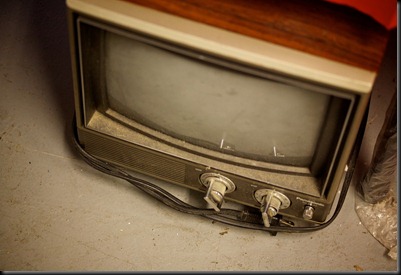
On top of the old TV sat a gray-brown box with two rotary dials that would make a loud clicking sound as you turned them. This WAS the cable box of its day and you manually switched channels by the use of the two dials. One dial had numbers on it, while the other one had letters. The differing combinations would offer different channels.

(The remote control never entered my house until many years later. After all, it was only a few years earlier that we bought the first color television ever in our family, a Hitachi. I still have that TV in storage, and the colors were just as good the last time I hooked it up, as the day we brought it home from Dale Sanford Television, in Alameda.

Back then it seemed you got multiple channels for each of the THREE networks. This was way before Fox, WB and other newcomers came to play. All your news coverage was local, unless you happened to catch the evening national news, presented by Walter Cronkite (CBS), John Chancellor (NBC) or Howard K. Smith & Harry Reasoner (ABC). CNN wouldn't show up until I was in high school. And I can remember when Atlant's WTCG, proclaimed itself the first super station, being seen Coast-to-Coast thanks to cable TV.

TV Guide was something like 10 cents, and was a real guide, not the magazine you see these days. Beyond that, Bay Cablevision used to release a heavy paper guide that showed what was on HBO and the other special movie channels they had. There were three colors, Green, Red, and Yellow. Each one was a higher priced package. I remember us having the Red package, which included Green, but the Yellow package must've been financially out of reach because I remember looking at it and seeing what we wouldn't be getting. Also, movies were on, generally, for three months, before something else rotated in.

To get HBO, there was a special filter you connected to your cable box by way of a patch cable, and then the outside cable from the telephone pole. It was apparently very important not to disconnect the filter because if you did, the cable man had to come out and set it back up. Not sure if that was real, or not, but that's what we were told. Also, there was a $50 deposit on that filter, which is comical because I think it was nothing more than a low or high pass, filter which probably cost $3.

* * *

But now we've reached another metamorphosis in the world of television entertainment, which will make today's television offerings seem as antiquated as my first experiences were in their day.

Though traditional broadcast channels and cable networks has the largest variety ever, it's also the hardest for a new producer to get into. It seems that networks will spend most of their production dollars on what they think are sure hits that will get them a high rate of return. That's why you're seeing so much Reality programing. It's relatively cheap, and fills what they perceive as being the viewer's most common wants.

However, in steps the Internet to fill a need. With higher and higher streaming speeds available, and storage costs plummeting, anybody can become a programmer. I'm a tech news junkie and more often than not I'm watching one of the TWiT.TV shows streaming on YouTube.

Leo Laporte has to be one of the most successful producers who has made a jump from traditional media to the Internet. After having his career controlled by others, he took the plunge and started netcasting his first show, This Week in Tech, in 2005, from an outbuilding on his property. Last year he made a move to a major production facility in downtown Petaluma, producing 29 shows, as well as maintaining a live 24/7 streaming channel. 

Chances are good that if there's a subject you are interested in, there will be some type of netcast about it. If not, there probably will be one shortly. And if you feel so inclined, you can start a program yourself. Most of today's smartphones have a good enough quality camera, which shoots high-definition video, which can be used till you decide to upgrade your equipment.

Monday, June 18, 2012

I had a dream…

Proportions_of_the_Head

Apologies to Martin Luther King, Jr. for borrowing his famous saying, but that's what came immediately to mind.

* * *

Have you ever had a dream that you immediately wake up from and can remember pretty much every thing that went on? I think most of us can say yes, to some extent or another.

A couple of days ago I had such a dream, and I can still remember pretty much all the major points as if I was experiencing it right now.

Not exactly sure what kind of company it was that I was working for. It had recently been taken over by some bigger company, and I was supposed to be  on the sideline of a high school football game the very next day.

Now here's where it got strange. For whatever reason, I had been given a metal water bottle earlier in the week. I had been carrying it around all the time, and it was supposed to record the sights and sounds of being on the sideline during the game.

At the meeting, I was shocked when the manager told me that this recorder had been live all week long. Every place I'd went. Every thing I'd said. EVERYTHING had been recorded into their database. Needless to say, I was very upset as I had been expecting it to only be active during the actual assignment.

We went back and forth about this for some time before I finally told them I would quit and then demanded they removed all recorded information from their computers. We were in the middle of removing records when I woke up. Or more exactly, my baying Jack Russell, Sally, woke me up, and I had to get up.

* * *

This dream brought to mind two things.

First off, what would you do if you found yourself in this situation. I studied to be a journalist when I went to the University of Montana (GO GRIZ!!). This was back before the Internet played such an important part in everyone's daily life. When most people wrote a physical letter rather than email through a computer program.

Journalism was a specialized field, with certain rules of form and style. People were columnists, not bloggers. In fact, the term "blogging" didn't even come into vogue until mid-1999, when Peter Merholtz coined it as a contraction of Web Log, which John Barger started using only a couple of years earlier. Now, as newspapers, one by one, are shuttering their doors anyone, with a computer and an Internet connection, can call themselves a blogger and share their wit and wisdom. (I can see the comments from the Peanut Gallery right now!!).

There's tons of awesome goodness on the Web where a person can have absolutely no idea about something, but within a few clicks of their keyboard have more answers than the venerable Encyclopædia Britannica. Unfortunately, there's also a lot of bad stuff that's totally inaccurate, and often misleading. The reader has to decide if they believe it, which may be hard depending on how much they knew to begin with.

Second thing brought to mind was regarding privacy and how much the freedom of information on the Internet has eroded that. Not so much little by little, but in a big "fire hose" deluge as of late. In fact, Google likes to use that phrase, fire hose, when talking about developers connecting to their collection of information and links.

And every time there's a minute change to the privacy statement at Google or Facebook people are screaming bloody murder as if they're giving away Social Security and bank account numbers. In reality, they are not publishing using anything that is not either publicly available or that you, as a user of some form or another has voluntarily provided them.

I scratch my head when people complain so much as if they expect these FOR PROFIT companies to give them what they want due to some altruistic belief.

In September 2011, Simon & Schuster published a book by American journalist Jeff Jarvis, called Public Parts. In it Jarvis argues against the common public perception that the Internet, and especially "social media," are making America a dumbed down society, surviving on sandwich-sized bites of information at a time.

Jarvis goes on to suggest  Society needs to protect the Internet as it belongs to everyone and for everyone's use. Just look at last year's Arab Spring. There is little doubt that had it not been for publicly available social media outlets, such as Twitter and Facebook, many countries in the Middle East and North Africa would still be under the thumb of their dictatorships.

People just need to make sure they educate themselves when they fill in their private information to understand where it might be used by the organization they're giving it to. They also need to understand it WILL be used by the organization for their needs, which might include sharing it with other organizations.

Monday, April 14, 2008

Remembrances of the Holy Land (Bethlehem)

BETHLEHEM
PHOTO: Dave Kim

Energized after decompressing over lunch, it was time to get in the Way back Machine again, this time to see Bethlehem.

We now encountered the Separation Wall, which Israelis have built to separate the West Bank from Israel. At this point, it's around 30 feet tall, and made of concrete with viewing towers at the top. Nice colorful photos and writing adorns the wall, giving it a comfortable appearance.

(The Israelis have said the Wall was built to combat suicide bombers from getting into Israel. Ignoring the charged politics of the situation, the raw numbers suggest "that goal" has been achieved, dropping from a high of 202 in 2002 to only a single incident by the time we visited in 2008.)

Adi pulled the bus up to some Israeli inspectors. He was asked to back us up into a location further from where we were. All of a sudden he left the bus. Doron followed and had a rather heated discussion with the soldiers.

After a few more exchanges Doron, not Adi, got back on the bus and hopped behind the wheel. Without saying anything he moved the bus up to the original spot we'd stopped. We all looked at each other and said, "Doron is driving the bus??" No explanation was shared as to what the reason for Adi having to leave the bus was.

Rules forbid Israeli citizens from crossing into the territories of the Palestinian National Authority so we could not use Doron's services as guide. We walked through the checkpoint to a bus that was awaiting us, along with a Palestinian guide.

As opposed to the other side of the almost anti-septic western Israeli side of the Wall, the Palestinian side was scrawled with graffiti, reminding me of pictures of the Berlin Wall in places. Further down from the entrance it was plastered with huge unflattering black and white posters of Jewish men and women, probably over 10 feet tall.

They looked like they were taken with some type of wide angle lens that accentuated the size of their noses. And if that wasn't bad enough, some where pointing towards their noses to remind visitors of the stereotypes typically used to put Jews down as a race.

As we departed from the Wall zone, we found ourselves going through the business districts of Bethlehem. There was definitely a different look and feel compared to the other side.

Whereas everything in Jerusalem was relatively clean, with a brightness to the colors. Here, in Bethlehem, things were muted with a general dustiness.

We passed through Bethlehem to a rural area outside the city to the Shepherds' Field are located. This is where the Angel of the Lord brought the wondrous news of Jesus' birth to the lonely shepherds tending nearby flocks. (Some people question the December timing as it's unlikely they'd have their flocks out in the heart of Winter).

Here, there were several grottos set up for visitors to go into. For whatever reason the caretakers felt the need to decorate in a Christmas-like theme year-round. The ceiling of the cave was painting a light blue, with white stars scattered throughout. There were also lights set up inside.

Our group was small enough that we could sit on ledges hewn into the rock along the edges. TS gave us a sermon about the night Jesus was born, and we then proceeded into CM leading us in worship.

I've never been one to sing in public. Call it shyness. Call it not being confident in one's voice. It's just not something I like to do. However, in this close proximity with others who were all doing so, it was easier to do than stick out like a sore thumb. GC who was sitting to my immediate right, made it easier by sharing a song book with me without my asking.

On our return to Bethlehem, we went to the Church of the Nativity, which most people agree is the likely birthplace of Jesus Christ, no matter what time of year it actually occurred.

Buses were parked away from the actual building, and you first walk into Manger Square, a stone paved area in front of the old church.

We entered through the Door of Humility, a 51" high door where a visitor is required to bend over to enter, more of a burden for people like TG, MG and myself, than others. As the story goes, it was an added benefit during Crusader times because a mounted rider would not be able to take his horse or camel through the small entrance.

Because of this being the second most important site in Christianity it's has been fought over by the different religious sects for centuries. An agreement was finally reached that the Roman Catholic, Greek Orthodox and Armenian Apostolic churches would manage the administration of the building. They were the only groups occupying the church at the time.

(Yet, that agreement hasn't always keep the peace. A huge brawl started between Armenian and Orthodox priests in December 2011 when someone moved a ladder over too far to dust a chandelier that wasn't quite in their area of control!)

Walking in and passing through the small narthex, we find ourselves in the old basilica with its wide room filled with huge columns to support the roof. Continuing to the right, we entered a smaller section that was loaded with Greek Orthodox paintings and Iconographic art. The pungent aroma of incense thick in the air.

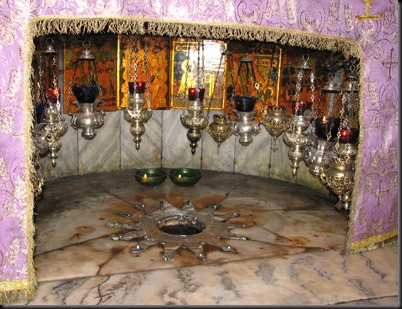
The actual access into the Grotto is by a small wedge shaped stair case. There was also a minor traffic jam to get in because the Silver Star marking the place of Jesus' birth (as was decided by Empress Helena's architects) is within a few feet of the bottom step. As pilgrims reach the site, many place their Holy Bible on the star, the idea doing so will bless the Book with even more spiritual power beyond the Word. Some even kneel down to kiss the glass lens.

Taking a moment, I placed my Blackberry (with the previously mentioned Bible software) on the spot. Our course, it really was really just a Verizon loaner, so someone somewhere else has been bestowed with that spiritual blessing, though the software was wiped before returning.

The Grotto was very crowded, with a lower than normal ceiling built for a time with shorter people. If you were to look from overhead it's actually shaped like a body with two outstretched arms. The star is at the head. Once we'd had our chance by the alter we headed farther back into the body section, and a small section cordoned off so TS can give us some thoughts to take away.

Originally, there was only one entry point, which meant you'd have a crowd of people trying to get in while others were trying to come out the same way. Eventually another exit was added to the left of the star.

Outside the Grotto we now entered the area claimed by the Armenian Apostolic Church. There was a group that someone said was from the Syriac Orthodox Church. They were deep in worship, rhythmically marching counter clockwise, reciting a melodic chant. I wish I'd been able to capture it on video, it was so mesmerizing. I guess CB made the mistake of briefly sitting on one of the chairs in the area and someone quickly chased her away.

Back in the Basilica there was an doorway that took us into the adjacent Church of St. Catherine. This modern basilica is managed by the Roman Catholic Church, and was built over the top of to Byzantine churches. Evidence of which is protected in the main basilica floor. Then there was a small hallway that took us down in the bottom where the grotto of St. Jerome is located.

After exiting the church there was a gorgeous courtyard full of greenery and statues decorating the exterior.

Boarding the bus, we were taken to a huge souvenir store across town. This one was owned by Christians so it was particularly happy to see our business. It had aisles and aisles of items made from carved olive wood. I saw a manger set that was really tempting.

The owners found out that CM and RC were musicians and asked if they would brighten the place up with some worship music. They did and other shoppers enjoyed the set.

TS and the guide herded us up towards the front counter to make any purchases. This took a lot longer than I would have expected from the length of the line.

Our bus was supposed to be waiting outside. We waited and waited and waited. Some started to worry that perhaps they'd actually forgotten us.

While we waited a street vender came buy selling traditional Arab Keffiyeh,  the checkered wraps we're used to seeing in photographs. He talked SeL and SH into buying.

At first SeL told the guy he didn't want to get it because he'd never remember how to fold it right. However, the salesman talked them into it by promising to show him how to do it right. SeL got the red one and SH got one reminiscent of Yasser Arafat.

Rather than leave after he'd made his sales, he stood around just to chat. He said he'd lived in the USA at one time, but decided to come back to the Middle East. He started talking about the politics of President George W. Bush, to which nobody wanted to take part in. Sensing the conversation was quieting he headed off for some new faces. (We'd been warned before the trip not to get involved with political discussions.)

Still waiting for our bus, I noticed CB talking with a 30-something Palestinian. He was dressed well in western-style clothing. He said something to her and she giggled. He apparently said something again and she smiled and moved away from him.

I asked her what that was about? At first she didn't say, but then whispering in my ear, "How many camels?!?!?!" I looked at her perplexed. Apparently, he wanted to know how many camels her husband would take in trade for her as a bride. A strange joke to say to someone, wouldn't you say?

With much rejoice we finally saw our bus show up. Quickly piling on, we headed back to the inspection point to reenter Jerusalem and headed for the hotel.

Upon walking into the hotel we're stopped in our tracks, and cannot get to the elevators. A Hasidic wedding party had contracted with the hotel for use of the main ballroom. We arrived as the bride and groom were leaving.

Men, dressed in all black black suits and fedora hats escort the bride and groom across the foyer to the elevators to the accompaniment of rhythmic clapping. The bride is dressed in a flowing white gown while her groom stands out with a grey suit with plain yarmulke. As the newly weds waive good-bye and step into the elevator car, a couple of the men grab a young boy and push him for the ride up to their room.

Since the main ball room isn't available, the hotel has set up the dinner buffet in an alternative location. It wasn't nearly as extensive as what they'd seen for breakfast, and is must more cramped.

Back in the comfy confines of my hotel room, I tried my luck at watching the Sharks' most recent playoff game. Internet wasn't free here in Jerusalem though. Many major hotels in this part of the World have figured out they can charge for the Internet. And they charge based on how much data you download. If you're going to do a lot of data, such as streaming video, you're basically forced to spend US$20 for 24 hours of connection. YIKES!!

The connection worked great. I was able to start watching the game, and I was excited to be catching a game. I laid down in bed while watching. BIG MISTAKE!

I think I got through the first part of the 1st Period, and then fell asleep. I woke up several hours later after missing most of what I'd recorded, and decided it wasn't worth trying to rewind it and watch the rest.

TO BE CONTINUED…